|

Bill Gates to invest in Zimbabwe
GATES FOUNDATION EMERGENCY RESPONSE TO EBOLA
The Bill & Melinda Gates Foundation today announced
that it will commit $50 million to support the scale
up of emergency efforts to contain the Ebola
outbreak in West Africa and interrupt transmission
of the virus.
The foundation will immediately release flexible
funds to United Nations agencies and international
organizations involved in the response to enable
them and national governments to purchase badly
needed supplies and scale up emergency operations in
affected countries. In addition, the foundation will
work with public and private sector partners to
accelerate the development of therapies, vaccines,
and diagnostics that could be effective in treating
patients and preventing further transmission of the
disease.
"We are working urgently with our partners to
identify the most effective ways to help them save
lives now and stop transmission of this deadly
disease," said Sue Desmond-Hellmann, CEO of the
Gates Foundation. "We also want to accelerate the
development of treatments, vaccines and diagnostics
that can help end this epidemic and prevent future
outbreaks."
To date, the Gates Foundation has committed more
than $10 million to fight the Ebola outbreak,
including $5 million to WHO for emergency operations
and R&D assessments and $5 million to the U.S. Fund
for UNICEF to support efforts in Liberia, Sierra
Leone and Guinea to purchase essential medical
supplies, coordinate response activities, and
provide at-risk communities with life-saving health
information. An additional $2 million will also be
committed immediately to the Centers for Disease
Control and Prevention to support incident
management, treatment, and health care system
strengthening.
In August, Nigeria responded to the current crisis
by opening an Emergency Operations Center (EOC) in
Lagos, with support from the foundation and the
Dangote Foundation. Leveraging expertise and lessons
from the national polio program, the EOC has been at
the center of an aggressive push by the federal and
state governments to contain the spread of the
virus, and there is cautious optimism that this
prompt action may have helped avert a broader
outbreak.
As additional grants are made, the foundation will
provide further details on its funding commitments
to on-the-ground operations and to research and
development for Ebola drugs, vaccines, and
diagnostics.
About the Bill & Melinda Gates Foundation
Guided by the belief that every life has equal
value, the Bill & Melinda Gates Foundation works to
help all people lead healthy, productive lives. In
developing countries, it focuses on improving
people's health and giving them the chance to lift
themselves out of hunger and extreme poverty. In the
United States, it seeks to ensure that all
people—especially those with the fewest
resources—have access to the opportunities they need
to succeed in school and life. Based in Seattle,
Washington, the foundation is led by CEO Sue
Desmond-Hellmann and Co-chair William H. Gates Sr.,
under the direction of Bill and Melinda Gates and
Warren Buffet
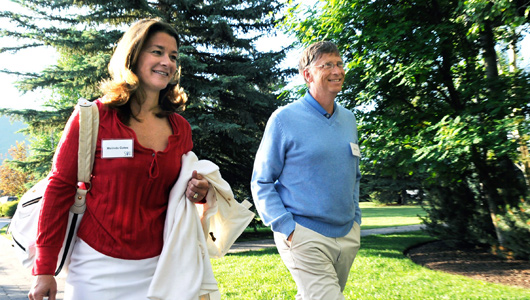
HARARE – Bill and Melinda Gates (pictured) foundation has
come back to Harare again but this time around, the
philanthropists are coming in as investors. The US- based
organisation headed by former Microsoft chairman, Bill
Gates, who, according to Forbes Magazine, is the second
richest man in the world is looking for means of investing
in Zimbabwe.
Harare Mayor Muchadeyi Masunda told the Daily News on Sunday
the Seattle- based foundation which has an estimated wealth
of $56 billion, was exploring means of investing in Harare –
targeting raw sewer and other disposable waste with a view
of turning it into energy.
“The Bill and Melinda Gates Foundation has engaged a team of
consultants led by Peter Smuts of Pasco Waste and
Environmental Consulting to have a look at our solid waste
with a view of assisting us with the installation of
facilities to convert waste into money,” said Masunda.
According to Masunda, the project will address at least two
of the eight Millennium Development Goals (MDGs), of
eradicating poverty by creating employment and reducing
environmental degradation through the elimination of
industrial and domestic pollution.
“Council shall push for a tripartite business model
involving itself as the designated local authority, the Bill
and Melinda Gates Foundation in conjunction with a local or
foreign technical partner and the community where the waste
is being generated,” Masunda said.
The envisioned venture between council and the foundation
follows a successful visit by Melanie Walker, a senior
programme officer last year to monitor a $5 million housing
grant sponsored by the organisation. The project initially
targeted Mbare residents, but was later moved to
Dzivaresekwa due to political resistance from a Zanu
PF-aligned group – Chipangano.
The “notorious” group, described by Masunda as “loose
cannons,” successfully scuttled hopes of more than 500 Mbare
families to benefit from an ambitious housing project. They
demanded a share into the project before accusing the
initiative of being an MDC election campaigning gimmick.
Harare City Council just like many other urban local
authorities is directly controlled by the Morgan Tsvangirai-led
MDC. Masunda could not divulge the exact amount the project
will cost preferring to estimate that an initial capital
injection of $1 million is hoped for.
Bill & Melinda Gates Foundation Support Agriculture in
Africa with $56 Million
 The
Bill & Melinda Gates Foundation have provided the Alliance
for a Green Revolution in Africa (AGRA) with a $56 million
grant to support agriculture in sub-Saharan Africa. The
Bill & Melinda Gates Foundation have provided the Alliance
for a Green Revolution in Africa (AGRA) with a $56 million
grant to support agriculture in sub-Saharan Africa.
The money will be utilized by AGRA to provide disease
resistant seeds of important crops that produce higher
yields to poor farmers.
It is hoped that this will help to increase their
productivity and reduce hunger and poverty.
AGRA’s Program for Africa’s Seed System (PASS) has been
largely successful since its launch five years ago.
PASS programme director, Dr. Joe Devries said, “In Africa
, farmers have largely not benefited from improved seeds due
to a lack of localized crop breeding and efficient,
dependable seed delivery system. And so crop yields in most
of Africa have remained one-third of those produced by
farmers in other developing regions of the worlds.
“Good seed is not just
the driving force behind good harvests and eliminating
poverty and hunger, it’s the foundation for rapid economic
growth.”
PASS aims to increase the number of companies providing
it with seeds to 100 by 2017, and improve its capacity to
200,000 metric tonnes of seeds to support 10 million small
farmers.
The grant was announce by the co-Chair of the Bill and
Melinda Gates Foundation in Rome during the International
Fund for Agriculture (IFAD) annual governing session.
The Foundation has contributed $2 billion to Agriculture
since 2006.
Bill Gates speaking at the session said, “If you care
about the poorest, you care about agriculture.
“Investments in agriculture are the best weapons against
hunger and poverty, and they have made life better for
billions of people. The international agriculture community
needs to be more innovative, coordinated and focused to
really
be effective in helping poor farmers grow more. If we can do
that, we can dramatically reduce suffering, and build
self-sufficiency.”
THE GATES
FOUNDATION
Bill and Melinda
Gates believe every life has equal value. In 2000,
they created the Bill & Melinda Gates
Foundation to help reduce inequities in the United
States and around the world. Headquartered in
Seattle, Washington, the foundation is led by
co-chairs Bill Gates, Melinda Gates, and William H.
Gates Sr., and by CEO Patty Stonesifer.
http://www.gatesfoundation.org/AboutUs/
We want to support
African farmers, who produce food under the most
difficult conditions, by improving the agricultural
sector from seed to market.
Jan 21, 2014 Schalk
van Zuydam/Associated Press
BILL AND
MELINDA GATES LETTER ARGUES AGAINST 3 POVERTY MYTHS
PHILANTHROPIST BILL GATES ASSERTS THAT THE WORLD'S
POOREST WON'T STAY POOR
Philanthropists Bill and Melinda Gates pitched an
optimistic future for the world's poor and sick in their
annual letter, arguing passionately against three myths
they say hurt efforts to bring people out of poverty,
save lives and improve living conditions.
In the past, their annual letter has focused
exclusively on the Bill & Melinda Gates Foundation's
activities. But in their sixth letter published
Tuesday, the co-chairs of the world's largest
charitable foundation sought to dispel false
notions that poor countries are doomed to stay poor,
that foreign aid is wasteful and that saving lives
will cause overpopulation.
"All three reflect a dim view of the future, one
that says the world isn't improving but staying poor
and sick, and getting overcrowded," Bill Gates
writes in the 16-page letter. "We're going to make
the opposite case, that the world is getting better,
and that in two decades it will be better still."
Myth No. 1: Poor are staying
poor
Gates says GDP per capita figures, adjusted for
inflation to 2005 dollars, show that many countries
such as China, India, Brazil and even Botswana that
were once considered poor now have growing
economies.
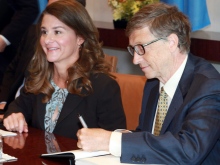
Bill Gates and Melinda Gates assert in their annual
foundation letter that decreasing child mortality and
population control go hand in hand. (David Karp/Associated
Press)
And in Africa, a place the Microsoft co-founder says is all
too often dismissed as hopeless, life expectancy has risen
since the 1960s despite the HIV epidemic. Also, more
children are going to school and fewer people are hungry.
"I am optimistic enough about this that I am willing to make
a prediction," he said. "By 2035, there will be almost no
poor countries left in the world."
CBC's As It Happens host Carol Off asked Bill Gates
whether he had taken into account the impact that climate
change could have by 2035, especially on fragile emerging
economies' water and food levels.
"I do mention that as you get countries to be affluent -
other problems come with that," Gates said to Off,
responding that development is important, but local
environment issues and health problems will also need to be
addressed.
Gates added that 90 per cent of climate change is caused by
"rich countries," and that the poor will suffer for it.
Myth No. 2: Foreign aid is wasteful
Gates says that development aid — for instance making
drought-resistant seeds available to poor farmers — would
mitigate the effects of climate change. He says that this is
one area where foreign aid could help poorer countries
improve productivity and avert starvation.
He argues against claims that foreign aid is wasteful
because it is too expensive, because it is stolen by corrupt
officials receiving it or because countries who receive it
become dependent on it.
"There are people who will take the worst programs that
didn't succeed in their goals and hold them up as though
they're representative," Gates says.
He says that in Norway, the world's most generous donor of
foreign aid, the amount of its budget that goes to foreign
aid is only three per cent. In the U.S., it's less than one
per cent, or about $30 billion per year, of which $11
billion goes to vaccines, bed nets and other health causes.
Measles vaccinations, eradicating smallpox, controlling
tuberculosis in China and a plan to eliminate polio in Latin
America are all public health efforts achieved with aid
funding.
"Health aid is a phenomenal investment," he writes. "When I
look at how many fewer children are dying than 30 years ago,
and how many people are living longer and healthier lives, I
get quite optimistic about the future."
Myth No. 3: Saving lives causes
overpopulation
His wife, Melinda, wrote a section of the letter dispelling
the myth that saving lives worldwide will lead to
overpopulation. She points to countries such as Brazil where
both child mortality and birth rates have declined.
When more children survive, she says, parents have smaller
families.
"We've developed a real excitement about the progress we
see," says Gates.
"We think helping out the world’s poorest and bringing the
benefits of new vaccines, new seeds to them is a lot of
fun." Bill Gates
"The planet does not thrive when the sickest are allowed
to die off,but rather when they are able to improve
their lives" she says. "Human beings are not machines.
We don't reproduce mindlessly.
We make decisions based on the circumstances we face"
The Seattle-based Bill & Melinda Gates Foundation is the
world's largest charitable foundation and has made $28.3
billion in grant payments since its inception 13 years
ago.
|





 A
GREAT GUEST HOUSE IN UGANDA.
A
GREAT GUEST HOUSE IN UGANDA.





 Section
Page
Section
Page