|
MALI -
"FROM TIMBUKTU TO WASHINGTON, D.C."
FEATURED AT SMITHSONIAN FOLKLIFE FESTIVAL
Submitted
by David Saunders
Washington,
D.C.: The Ministry of Tourism and Handicrafts for
the Republic of Mali showcased the rich culture of
Mali and its people at the Smithsonian Folklife
Festival on the National Mall, Washington, D.C, The
Malian program opens daily from 11:00am-5:30pm and
several evening events will occur 5:30pm-9:00pm.
This will be a fabulous opportunity for individuals
to learn more about the rich culture and history of
Mali as well as sample some traditional foods and
purchase exquisite handicrafts. Although in 1960,
the Republic of Mali reassumed the name of one of
the empires that had formerly flourished in the
region, its imperial legacy is much broader. Mali
includes part of the territory of the former
Kingdom of Ghana, which thrived from 400-500 A.D.
around its capital, Koumbi-Saleh, to the south of
present day Mauritania. Renowned for its great
wealth, in caravans trading and gold, the Kingdom
of Ghana was conquered and dismembered in the 9th
century by the Almoravid Berbers. Later, it was
partly incorporated into the Empire of Mali, which
reached its apogee in the mid-14th century under
Kankan Moussa. Imperial Mali thrived on the
trans-Saharan caravan trade routes, but declined in
the 15th century with the rise of the powerful
Songhai Empire, with its capital of Gao, and was
destroyed in turn towards the end of the 16th
century by Moroccan invasions. The later kingdoms
&endash; Bambara (around Segou), Fulani (Macina
region) and Toucouleur &endash; never attained the
same degree of power and influence.
However, despite
its rich cultural heritage and spectacular
geographical features, until recently, very little
was done to take advantage of Mali's immense
tourism potential. The new Minister of Tourism and
Handicrafts for the Republic of Mali, the Honorable
N'Diaye Bah, was quoted as saying "The opportunity
to promote Mali's ancient culture and startling
landscapes is about to change dramatically.
Currently, Mali receives about 200,000 tourists
every year and tourism is the third major industry
after gold mining and cotton. Investors are putting
up new hotels and Mali is also opening new roads to
also make it easier to get around the country". In
October, Timbuktu, the mysterious "City of 333
Saints" will host the 2003-2004 opening ceremonies
of the tourist season in Mali. The kick-off will be
launched by H.E. Amadou Toumani Toure, the
President of Mali on October 10, 2003. This major
event will provide visitors from all over the world
a unique opportunity to discover the hidden facets
of Timbuktu. In the nineteenth century, explorers
braved the extremely difficult route to a fabled
city known as Timbuktu in search of legendary
gold-paved streets that turned out to be a figment
of the imagination. Some people thought of Timbuktu
as the end of the earth but it was once the very
center of the world. Timbuktu has always been a
mysterious and inaccessible city, but 800 years ago
it was the world capital of the trans-Saharan
trade, full of caravans of salt and gold. There was
also a great university with 25,000 Islamic
scholars and people marveled at the wealth of
knowledge that the students gained from years of
teaching encompassing a diversity of studies. For
more information about how you can participate in
this event, please contact the Office Malien du
Tourisme et de l'Hotellerie (OMATHO) at their
e-mail address: omatho@le-mali.com.
Additionally, in
November 2003, Mali will host its first "Desert
Marathon" in which four hundred runners from all
over the world will cover 250 miles in the sands
north of Timbuktu. There will also be a nautical
rally down the Niger River. Minister N'Diaye is
currently enacting legislation to require tour
guides to be trained and licensed, and to help
protect the local culture that draws visitors from
all over the world, including anthropologists who
are fascinated by the mysterious cliff-dwelling
Dogon people. According to Minister N'Diaye, "Mali
intends to turn itself into the biggest tourist
destination in West Africa by 2005 with the
assistance of many North American travel and
tourism professionals".
In conjunction with
the Mali Programme at the Smithsonian Folklife
Festival on the National Mall, there was a Press
Briefing conducted by senior representatives of the
Office Malien du Tourisme et de l'Hotellerie for
the Republic of Mali on Monday, June 23, 2003. It
was held at the Embassy of Mali located at 2130 R
Street, N.W. in Washington, D.C. and several
journalists attended and received additional
information about the travel and tourism industry
of Mali as well as the Mali Programme scheduled to
occur as a part of the Smithsonian Folklife
Festival on the National Mall. In addition, a
delegation of Malian tourism officials led by the
Minister of Tourism and Handicrafts, the Honorable
N'Diaye Bah, spoke in detail about the tourism
opportunities of Mali to an audience of tour
operators, travel agents, group leaders and friends
of Mali at a Reception on Saturday, June 28th,
2003. This event took place at the Smithsonian
Center for Folklife and Cultural Heritage located
at 750 Ninth Street, N.W., Suite 4100, Washington,
D.C. At this Reception, Minister Bah informed the
guests that Mali was poised to take advantage of
the rare opportunity to be showcased during the
2003 Smithsonian Folklife Festival on the National
Mall. He stated "one hundred and twenty artists and
artisans from Mali, representing thirty-two
categories have made the journey to Washington,
D.C. in order to celebrate the living traditional
culture of Mali at one of the world's largest
cultural events." In addition to all of the eight
regions of Mali being represented in their cultural
splendor and diversity, an additional ninety
officials, scholars and local press representatives
will accompany the Malian Delegation. Also, the
President of Mali, H.E. Amadou Toumani Toure and
twelve members of his cabinet also participated in
this very important opportunity. Minister Bah also
stated "the Smithsonian Folklife Festival on the
National Mall has presented Mali with unique a
platform for daily and evening programs of music,
songs, dance, celebratory performance, crafts and
cooking demonstrations, storytelling, illustration
of workers' culture and narrative sessions for
discussing cultural issues. The overall expectation
of all of this effort will be for Mali to be
significantly placed into the minds of many
Americans in hopes of interesting them to visit
Mali as tourists in the near future." As a result
of this highly successful promotional campaign, the
Ministry of Tourism and Handicrafts of the Republic
of Mali has decided to reopen the Mali Tourism
Office in New York later this year.
In addition to
Minister Bah's passionate message about Mali's
participation in the Smithsonian Institution's
Folklife Festival on the National Mall, there was a
presentation video that highlighted the wide
diversity of tourism attractions in Mali as
follows: First and foremost, Mali is home to three
unique tourism attractions that have been
designated by UNESCO as World Heritage Sites
&endash; Djenne, Timbuktu and the Dogon Country.
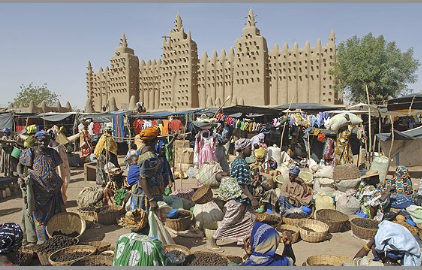
Djenne, known as the "Architectural Jewell" of
Mali, was founded in the 4th century and has
scarcely changed since the Middle Ages. Djenne was
also a rival city of Timbuktu for the wealth of the
trans-Saharan trade and is located on an island in
the inland Niger Delta. Djenne is surrounded by
mud-brick walls, from which generations of highly
skilled master-builders, the Baris, have ensured
Djenne's architectural integrity. Djenne has a
marvelous mosque, which is the greatest mud-made
monument in the world, and has been designated as a
UNESCO World Heritage Site. It is replenished
annually in April during a citywide celebration.
Djenne also is known for its captivating Monday
market and Koranic schools.
Timbuktu, another
UNESCO World Heritage Site, was formerly a great
commercial city and an international center of
Islamic learning. Timbuktu was also a leading
terminus of the trans-Saharan caravans and a major
distribution point for trade along the upper Niger
River. Merchants from northern African cities
traded salt and cloth for gold and black African
slaves in the markets of Timbuktu. Timbuktu has
several ancient mosques, of which the most famous
is the Sankore, whose reputation spanned all across
North Africa and Europe as a leading Islamic
academy for centuries. Timbuktu also has the Ahmed
Baba Center where most of the ancient books and
manuscripts are still preserved. On the outskirts
of Timbuktu, you can enjoy a camel ride into the
desert in order to visit the Tuareg encampments.
Here you will be able to meet the mysterious "Blue
Men" and discover their daily lifestyles, culture
and traditions. The Tuareg formed one of the most
ancient tribal people of the Sahara and in ancient
times, controlled the trans-Saharan routes and
subsequently contributed to the expansion of Islam
in sub-Saharan Africa. The Tuareg speak a Berber
language, Tamacheq, have their own alphabet and
have retained many of their customs and traditions
to this day. The Tuareg symbolize the mysteries of
the Sahara and are seen as "Masters of the
Desert".
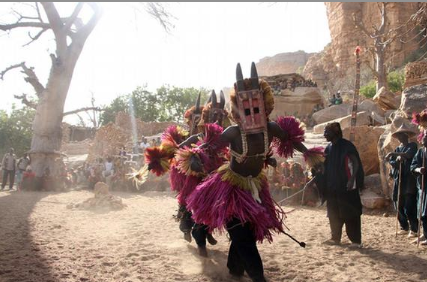
The Dogon Country
is recognized as one of the most extraordinary
places on earth and is such a unique place that
UNESCO has also declared it a World Heritage Site.
In the 11th century, the Dogon people fled the
advancing Arabs coming from the north and found
shelter in one of West Africa's most inhospitable
areas. Protection from their enemies was obtained
by building their villages high up on the vertical
faces of the 125 mile long escarpment known as the
Bandiagara Cliffs. The Dogon people are animist,
worshipping their ancestors and the spirits of
nature. They have managed to preserve their
traditions down through the centuries and are
considered to be one of the most original
civilizations of West Africa. Other major tourism
attractions in Mali include Bamako, the Capital
City, with its panoramic view from the Koulouba
Hills, the National Museum and vibrant Craft
Markets. On the outskirts of Bamako, you can visit
the Bambara culture and traditions in Sanankoroba
or Tandiana. Mopti, the sister city of Djenne, is
known as the "Venice of Mali" and is situated at
the confluence of the Bani and Niger Rivers. It is
built on several interconnected islands, whose port
is one of the busiest on the Niger River. Mopti is
literally teaming with traditional traders offering
a wide variety of locally produced commodities and
beautiful artifacts. On the outskirts of Mopti, you
can enjoy a pirogue ride on the Niger River and
visit the picturesque Bozo and Fulani villages
along the shoreline. Also not to be missed is
Segou, with its well-preserved Sudanese colonial
architecture and picturesque setting along the
Niger River bank.
In conjunction with
the above information, Minister Bah spoke briefly
about a Partnership on Cultural Heritage between
Mali and the World Bank. Through the Urban
Development and Decentralization Project, the World
Bank provides cultural support to the Government of
Mali for a program of rehabilitating and
safeguarding historic monuments, ancient documents
and cultural expressions. The World Bank project
will focus on the three sites classified as World
Heritage Sites by UNESCO: The city of Timbuktu,
with its mud-brick architecture and long history as
a center of trade, religion and learning in West
Africa; the city of Djenne, with its prehistoric
origins and spectacular mud-brick mosques and
houses; and the Dogon Country, a region of cliff
dwellings and sacred sites, symbolic city structure
and domestic decoration, and singular cultural
implements (i.e. &endash; masks, instruments and
dance paraphernalia). In each of these sites, the
project will be designed to strengthen management
of cultural heritage through the provision of
equipment in cultural centers and museums, and
training in management and preservation of
monuments, cultural implements and historic
documents. Thus, the World Bank proudly joins the
Government of Mali in the preservation of its rich
and varied cultural heritage. For more information
about the World Bank's Cultural Heritage projects
in Mali, please visit their website at
www.worldbank.org.
At the conclusion
of the Reception, the Ambassador of the Republic of
Mali to the United States, H.E. Abdoulaye Diop, led
the assembled guests in congratulating the Minister
of Tourism and Handicrafts of the Republic of Mali
and his colleagues in the travel and tourism
industry of Mali with showcasing the success of the
Mali Programme at the Smithsonian Institution's
Folklife Festival on the National Mall. Afterwards,
everyone was invited to attend a concert featuring
Malian musician Oumou Sangare at the Timbuktu
Pavilion.
Country Profile:
Mali is a landlocked nation in West Africa roughly
three times the size of the state of California in
the United States. It is bordered on the northwest
by Mauritania, on the northeast by Algeria, on the
east by Niger, on the south by Burkina Faso and
Cote D'Ivoire, and on the west by Guinea and
Senegal. The more than 4,000 km Niger River flows
northeast from Guinea through the heart of Mali
into the Sahara Desert and the Sahel Belt,
bordering the desert, extends from Senegal and
Mauritania through Mali. Mande-speaking peoples,
consisting of the Bambara, Malinke (Manding or
Mandinka) and Sonike, account for half of the
population. Other significant ethnic groups include
the Fulani, the Senufo, the Dogon and the Songhai.
The nomadic Tuareg are mostly concentrated around
the scattered oases of the Sahara to the north of
Timbuktu and Gao and speak Berber. There are
approximately 12 million inhabitants and about 80%
of the population is Muslim and the rest is split
between Christianity and traditional beliefs. Mali
gained its independence from France on September
22, 1960 and its current Head of State is H.E.
Amadou Toumani Toure who came to power in May of
2002. He is affectionately known by his people as
"ATT" and has earned a reputation as an exceptional
leader by successfully consolidating the country's
democracy into a stable and peaceful political
climate. The main cities of Mali are Bamako, (the
capital), Segou, Mopti, Sikasso and Gao and the
principal languages are French (official) with
Bambara, Fulani, Senoufo, Soninke, Tamacheq,
Songhai and Dogon.
Economic Climate:
Mali is Africa's fourth largest gold producer and
the largest producer of cotton in Sub-Saharan
Africa. Since 1992, the emphasis has been on free
trade and private enterprise, promoted in
cooperation with the International Monetary Fund
(IMF), World Bank, and bilateral donors, including
the United States. Economic activity in landlocked
Mali depends largely on farming and fishing along
the Niger River and even though only 30% of the
total land area is arable more than 80% of the
people make a living in agriculture. Other cash
crops are groundnuts, sugar cane and rice. Food
crops include millet, sorghum and maize. Livestock
is responsible for half of the agricultural
sector's activity. Mali is self-sufficient in
freshwater fish and a significant exporter. Gold
mining has become an important contributor to GDP
and has attracted considerable foreign interest,
including leading mining producers in South Africa
and Canada. Mali also has deposits of bauxite, iron
ore and tin. Prospecting is underway for petroleum,
copper, lithium and diamonds. Manufacturing is
mainly confined to small-scale agricultural
processing for domestic consumption and export.
Other industries include soft drinks, textiles,
soaps, plastics, cigarettes, cement, bricks, and
agricultural tools and equipment.
Submitted by David
Saunders,
Venue International Professionals, Inc. (VIP)
|