|
HOW NELSON
MANDELA'S EXAMPLE OFFERS STYLE LESSONS
By Vanessa
Friedman
"Nelson Mandela clearly took clothes - and their
power - seriously, and perhaps we should,
too".
Example,
Jerry Bird, Publisher and Editor of Africa
Travel Magazine will wear often a "Madiba
shirt" and African hats with pride in Africa,
USA and Canada.
Almost a
month after the death of Nelson Mandela, every
talking head has sighed in with their own memoir
or eulogy so what is there to add? Fair question
Let me simply say that this is a new year’s
column – a look forward, not a look back – and
it is about a lesson I think worth taking from
Mandela and applying in 2014, a lesson not
included in the many “Lessons from Mandela”
written in recent weeks. Most of these were
concerned with choosing reconciliation over
revolution, while this is to do with clothes. It
may seem like a frivolous topic where someone
such as Mandela is concerned, except he clearly
took clothes – and their power – seriously, and
perhaps we should, too.
Picture any G8 or even G20 meeting and, women
aside, there is a startling homogeneity to the
dress, the theory being that those who dress
alike, negotiate alike. As the former Indonesian
vice-president Jusuf Kalla was quoted as saying:
“Nelson Mandela dared to wear batik in the UN
General Assembly. If it was me, then I might
still hesitate to wear batik and speak in the UN
General Assembly, but he did not.”In a
world where leaders rarely stray from an
accepted uniform, no matter where they live –
dark suit, white or blue shirt, red or blue tie
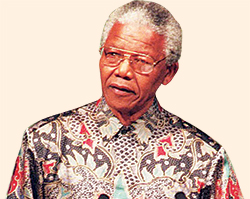
– Mandela stood out in his colourful batik
shirts. They not only made him visible wherever
he went but served a variety of more covert
purposes: advertising his independence from what
went before, underscoring his allegiance with
the traditions of his country and providing a
form of outreach to minority groups that each
interpreted in their own way.
More than any leader I can think of, Mandela
demonstrated how clothes can be a strategic
expression of individuality, even for a
politician. And he did it without adopting
another widely used uniform, the military jacket
– the general default option ever since
Napoleon.
Consider the fact, however, that, when he was
elected, Mandela wore a suit and tie just like
every other man in his position. It was only
after a few months that he began to wear batik –
and wear it, and wear it, to the extent that it
became so synonymous with his image that it took
his name (the “Madiba” shirt), and when Giorgio
Armani offered to dress him, he respectfully
declined.
Mandela had found his signature. It meant: (a)
anyone else who wore batik automatically became
associated with him; and (b) when he chose to
change from it, it was an act loaded with
meaning. See, for example, when he wore a
Springbok jersey in the 1995 Rugby World Cup,
and the following year when he wore a “Bafana
Bafana” football shirt for the African Cup of
Nations. Not to mention his willingness to bend
his own rules when necessary. According to the
designer Oscar de la Renta, Mandela was once
invited for dinner at the home of Harry
Oppenheimer, then-chairman of De Beers – “as
long as he wore a tie”. He wore the tie.
. . .
Like most symbols, the Madiba shirt became the
subject of several origination myths. On the
Judaism website chabad.org,
a writer called Avraham Berkowitz recalls a
conversation with Mandela about a visit to a
Jewish synagogue in Cape Town in 1994 when a
woman in the congregation gave him a
black-and-gold fish-print shirt. According to
Berkowitz, Mandela said: “After I’d worn that
shirt, this same woman [white South African
designer Desré Buirski] would continue to send
me shirts. We become good friends, and she
designed hundreds of shirts for me. These shirts
help me carry my message all over the world.”
South African GQ, however, also attributes
the shirts to fashion designer Sonwabile Ndamase,
and points out that “by wearing fabrics rooted
in southeast Asian cultures, Mandela reached out
to the Cape Malay community of South Africans”.
Burkina Faso-born tailor Pathé Ouédraogo is
another reported provider of Mandela’s shirts.
Meanwhile, Indonesia has hailed Mandela for
helping to make its batik globally known. It is
said that President Suharto gave him his first
batik shirt when Mandela visited the country
shortly after his release from prison, and he
also went on to wear many shirts by Indonesian
designer Iwan Tirta. Mandela’s batik shirts were
seen in Indonesia as a symbol of the parallels
between South Africa’s anti-apartheid movement
and its own anti-colonial movement.
Whatever the reality (and Mandela probably wore
shirts by all of the above during his long
batik-wearing career), it is clear this garment
was not a bad communication tool. With clothing,
as with politics, Mandela made different
individuals feel connected to his cause and used
his clothing to further his politics.
It is a model that other politicians might do
well to consider. Suits are, no question, the
safe option. Perhaps it’s time to think more
broadly, not just about constituencies but about
what constitutes imagineering. That is a
resolution worth making in 2014.
MANDELA SPURS TOURISM SURGE
South Africa is expecting a tourism boom
following Mandela’s passing, coinciding with
the release of the new film biopic ‘Mandela:
Long Walk to Freedom’ in January 2014, the
Herald Sun reported.
“Not only is there a significant influx of
foreign visitors to our destination, but
domestic travel will rise too as people
travel to attend memorial events, to be
present at the funeral in Qunu and embark on
the annual festive season holiday period,”
South African president Jacob Zuma said.
More than 100 current and former heads of
state travelled to South Africa in order to
attend the national memorial service for
Nelson Mandela at FNB Stadium in Nasrec
yesterday.
Visitors to South Africa can visit Mandela’s
home town, the prison where he was jailed
for 27 years and eat at the Mandela family
restaurant, all in attempt to understand a
nation’s battle for liberty.
Tourists can visit Robben Island, now a
World Heritage listed site, where Mandela
was locked away from 1963 to 1990, plotting
the abolition of the racist apartheid
regime.
“Mandela opened up our beautiful country to
the rest of the world and his name alone has
attracted millions of tourists wanting to
walk in his footsteps to South Africa every
year,” South African Tourism chief executive
Thulani Nzima said.
Mandela ... The
Book

Mandela-
the Book:
Just recently our editorial staff received
a beautifully bound book on the life and
times of Nelson Mandela, South Africa's
gift to the world. We will present our
review of this timely treasury on this
website and in coming editions of Africa
Travel Magazine. We will also give you the
details and how you can obtain your
personal copy, which we are sure yoiu will
value for a lifetime. Jerry W. Bird,
Editor
Profile
of Nelson R.
Mandela
From
ANC Web Site

Nelson
Mandela's greatest pleasure, his most
private moment, is watching the sun set
with the music of Handel or Tchaikovsky
playing. Locked up in his cell during
daylight hours, deprived of music, both
these simple pleasures were denied him for
decades. With his fellow prisoners,
concerts were organized when possible,
particularly at Christmas time, where they
would sing. Nelson Mandela finds music
very uplifting, and takes a keen interest
not only in European classical music but
also in African choral music and the many
talents in South African music. But one
voice stands out above all - that of Paul
Robeson, whom he describes as our hero.
The
years in jail reinforced habits that were
already entrenched: the disciplined eating
regime of an athlete began in the 1940s,
as did the early morning exercise. Still
today Nelson Mandela is up by 4.30 am,
irrespective of how late he has worked the
previous evening. By 5 am he has begun his
exercise routine that lasts at least an
hour. Breakfast is by 6.30, when the days
newspapers are read. The day s work has
begun.
With a
standard working day of at least 12 hours,
time management is critical and Nelson
Mandela is extremely impatient with
unpunctuality, regarding it as insulting
to those you are dealing
with.
When
speaking of the extensive traveling he has
undertaken since his release from prison,
Nelson Mandela says: I was helped when
preparing for my release by the biography
of Pandit Nehru, who wrote of what happens
when you leave jail. My daughter Zinzi
says that she grew up without a father,
who, when he returned, became a father of
the nation. This has placed a great
responsibility of my shoulders. And
wherever I travel, I immediately begin to
miss the familiar - the mine dumps, the
color and smell that is uniquely South
African, and, above all, the people. I do
not like to be away for any length of
time. For me, there is no place like
home.
Mandela
accepted the Nobel Peace Prize as an
accolade to all people who have worked for
peace and stood against racism. It was as
much an award to his person as it was to
the ANC and all South Africa s people. In
particular, he regards it as a tribute to
the people of Norway who stood against
apartheid while many in the world were
silent.
We know
it was Norway that provided resources for
farming; thereby enabling us to grow food;
resources for education and vocational
training and the provision of
accommodation over the years in exile. The
reward for all this sacrifice will be the
attainment of freedom and democracy in
South Africa, in an open society which
respects the rights of all individuals.
That goal is now in sight, and we have to
thank the people and governments of Norway
and Sweden for the tremendous role they
played.
More of
Nelson Mandela Profile to
come
REMEMBERING
MANDELA COURAGE AND TRIUMPH
I
remember where I was when Nelson Mandela
died on December 5, 2013: at work, preparing
for an important meeting. When I heard the
news, I did not want to be at the office. In
Vancouver, it was business as usual;
halfway around the world, though, the
Rainbow Nation started to grieve. When I
left my downtown office and walked onto a
dark Vancouver street, I suddenly felt a
deep sense of loneliness and loss. Although
Mandela was basically a stranger to me when
I was assigned to guard him as a member of
his security detail, a close bond based on
trust and protection quickly developed
between us. I worked with Mandela from May
1994 until February 1996, and on my last day
with him, I told him he was like a
grandfather to me; he leaned over, put his
hand on my shoulder, and said, “You are my
son.”.
Heading
home on a packed SeaBus, I wondered how many
people sitting there with me had heard the
news. How many of them knew what Mandela
meant to
South Africa? Later that evening I sat
in silence, watching the images of an
ever-growing crowd outside Mandela’s home.
Many mourners were quietly paying their
respects, appearing to inwardly reflect with
their own personal thoughts. But I also saw
the uplifting images of small groups of
people clapping, singing, and smiling. In
that moment, I more fully understood the
meaning of celebrating someone’s life when
they die. I felt I needed to go back to
South Africa—where I was born and lived for
33 years before moving to Vancouver—to be
there during that time of national grief. My
decision was partly because of my respect
for him, but mostly because of a gesture
from him to me more than 13 years earlier.
In May 2000, less than a year after
immigrating to
Canada, my wife passed away following a
scuba-diving accident. I went back to South
Africa for her memorial service, and while I
was there, Mandela called me to express his
condolences. He was no longer the president,
yet he still took the time to call me. I
wanted to go back as a show of appreciation
for his kind, heartfelt words all those
years earlier. I knew that, because of tight
security, I would not make it to the actual
funeral. However, I just wanted to be on
South African soil, closer to Mandela.
So on
December 11, I boarded a plane to South
Africa. That day I started reading Mandela’s
autobiography, Long Walk to Freedom.
I have a treasured copy of the book with a
personal message from Mandela inscribed in
it, which says, “Compliments and best
wishes”. What makes the message special is
that he acknowledged my rank—major at the
time, even though I had come through the
lower ranks while I was in the pre-democracy
police force—that he wrote it in Afrikaans,
and that it was signed on Christmas Day
(1995). Mandela signed it while we were with
him in Qunu, his childhood village. He
always took the time to tell us that he
appreciated the sacrifice we made in giving
up our time with our loved ones to accompany
him on trips around the world and to his
village, sometimes for as long as three
weeks, and sometimes over the festive
season.
On one
such trip, around Christmas Day, hundreds of
local villagers were invited by Mandela to
his home for a meal. Mandela had bought
several sheep for the occasion, and some of
the men proceeded to slaughter them and cook
the meat on open fires. We bodyguards
watched this all from a distance, some of us
seeing something like this for the first
time in our lives. Later we helped carry the
meat to Mandela’s kitchen, and I noticed
that it still looked a bit raw. When I
walked into the kitchen, carrying a large
plate stacked high with chunks of partly
cooked meat, Mandela exclaimed, somewhat
mischievously, “Ah, Etienne, you must have
some meat!” He probably realized I was used
to buying meat from a butcher and cooking it
on a grill or in an oven. I felt obliged to
accept his offer, and managed one or two
mouthfuls before finding an excuse to go and
check something outside.
I told him he was like
a grandfather to me; he leaned over, put his
hand on my shoulder, and said, “You are my
son.”
Though I
cherish my copy of Mandela’s book, I had
never actually read it until that plane ride
back home. I always used to joke, “I know
the story, I don’t need to read it”; but in
reality, I did not know the story. Over the
coming days, I would get to know Mandela
better, after his death. I landed in South
Africa on December 13, the last day Mandela
lay in state at the Union Buildings. I
arrived at the buildings a few hours after
landing, only to discover that I might not
make it into the area where thousands of
people were lining up to file by him. This
was because only those arriving on buses
from designated gathering zones were allowed
into the area where I needed to be. Not
knowing this arrangement, I had gone
directly to the buildings. So I took
advantage of the somewhat disorganized crowd
control and tricked my way into the area,
joining one of the lines of people. I
remember thinking, “I’ve come this
far—there’s no way I’m not going to say
goodbye to my president.” Several hours
later, I filed past Mandela. I promised him
I would try to be more like him, and that I
would tell as many people as possible about
him. As I left the Union Buildings, I
recalled his words: “Death is inevitable.
When a man has done what he conceives to be
his duty to his people and his country, he
can rest in peace. I believe I have made
that effort, and that is why I will sleep
for eternity.” Mandela was buried on
December 15. The following day was South
Africa’s first day “without” him. It was
also the Day of Reconciliation, and has been
known as such since 1994, when Mandela
became president.
I awoke
at 4:50 a.m., still jet-lagged. It was
raining lightly and my thoughts drifted to
Qunu, where he now rests. Mandela was a
private person. Though I spent a lot of time
with him, he never shared any stories about
his childhood with me. Sometimes when we
walked through the rural areas around his
village, he would point to hills where he
used to play, but he never shared any
intimate recollections of his upbringing. He
did, however, frequently ask me about mine.
One of my most special trips with Mandela
was when we visited my hometown together on
an official visit, where he spent most of
the day meeting local farmers and community
leaders and addressing a stadium full of
people at a public gathering.
Someone
once said to me, “You walked beside a god.”
I know what that person was trying to say,
but it also made me realize, once more, what
an exceptional person Mandela was. He was
not a god; he was human. For me, he will
never die. He chose not to concentrate on
past grievances, but rather on
reconciliation. He showed that through
tolerance, patience, and understanding, you
can change how people think and act. When
Mandela called me all those years ago, he
said, “You have the courage to turn tragedy
into triumph.” And that is what this story
is about: courage and triumph. That is how I
remember Mandela.
|


