|
|

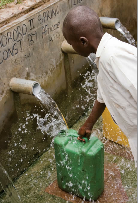 Africa
is plagued not so much by the shortage of water
as by its inaccessibility. Of all the renewable
water available in Africa, only 4 percent is
actually used each year —because most African
communities lack the money for building wells,
pumps, canals, reservoirs, irrigation systems,
and sanitation facilities essential to utilizing
the potential water supply. Where there are
rivers, farmers may have difficulty moving water
to their fields. In dry, desertified regions,
vast supplies of water “flow” underground,
exploitable only by deep wells. In sub-Saharan
Africa sanitation coverage is a mere 36 percent.In
fact the World Health Organization cites ten
Sub-Saharan African countries among the world’s
worst twelve with regard to the availability of
decent sanitation. Africa
is plagued not so much by the shortage of water
as by its inaccessibility. Of all the renewable
water available in Africa, only 4 percent is
actually used each year —because most African
communities lack the money for building wells,
pumps, canals, reservoirs, irrigation systems,
and sanitation facilities essential to utilizing
the potential water supply. Where there are
rivers, farmers may have difficulty moving water
to their fields. In dry, desertified regions,
vast supplies of water “flow” underground,
exploitable only by deep wells. In sub-Saharan
Africa sanitation coverage is a mere 36 percent.In
fact the World Health Organization cites ten
Sub-Saharan African countries among the world’s
worst twelve with regard to the availability of
decent sanitation.
Diseases caused by unsafe drinking water and
inadequate sanitation remain Africa’s most
serious public health threat, causing 80 percent
of the sicknesses and killing 5,000 children
every day. Lack of clean drinking water and
proper toilet facilities undermine the
sustainability of other critical needs,
including education, economic development,
nutrition, environmental health and gender
equality.
At its inception forty years ago, Africare
responded to the drought-stricken communities
throughout the then, six-country Inter-State
Committee for the Fight against the Drought in
the Sahel (CILSS). Construction of hand-dug
wells, rehabilitation of abandoned bore holes,
construction of earthen dams and the design and
implementation of large-scale river-based
irrigation schemes were major elements of
Africare’s earliest response to Africa’s
expressed needs for water in Niger, Mali, Chad,
Upper Volta (Burkina Faso), Senegal and
Mauritania.
Today, in more than twenty countries, water
continues to be an entry point in response to
village and government demand and an integral
component of Africare’s development and relief
activities in agriculture, health, education,
natural resources management and livelihoods.
Africare emphasizes the integration of water,
sanitation and hygiene in most of our projects.
We recognize that a well or spring with clean
water, when combined with hygiene education and
proper excreta disposal, reduces diarrhea and
other water-borne diseases. Additionally, clean
water sources near homes reduce the time spent
and the burden of women and girls fetching
water, often from more than five miles away by
foot. Separate and clean toilets for boy and
girl students at schools significantly improve
school attendance rates of girls. Over our
history, we have worked in thousands of African
communities to ensure reliable supplies of water
and sanitation facilities through the
construction of wells, springs, dams, boreholes,
rainwater catchments, latrines and hand washing
facilities.
Africare emphasizes appropriate technology and
community participation, training and
empowerment to ensure the sustainability of
water interventions as well as to seek gender
equity. We organize village water user
committees, which oversee water project
implementation and ultimately water point
maintenance and repair. Africare also helps
communities understand the connection between
polluted water and disease and the measures that
people must take to stay healthy.
NIGER is in many respects the birthplace of
Africare. In early 1970's, Africans and
Americans organized under the Africare name
to provide humanitarian relief during the
Sahelian drought of the early 1970s. Since
then
Africare has grown to become a leader in aid
to Africa- pioneering various types of
self-help development programs and noted for
its close collegial partnerships with the
people and leaders of Africa.
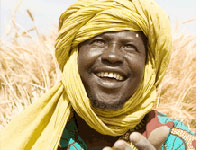 Watch
for the story of farming in Mali. in our
West Africa Edition (photo left) Watch
for the story of farming in Mali. in our
West Africa Edition (photo left)
Clean Water -- Life's Lifeline
AFRICARE BISHOP JOHN T. WALKER
MEMORIAL DINNER TO CELEBRATE CLEAN WATER
IN AFRICA
|
|
MALI SEED CARAVAN
Farmers
in Mali celebrate biodiversity with a seed
fair This past November, USC's country
office in Mali &endash; USC Afrique de
l'Ouest &endash; organized a seed caravan
and seed fair. About 130 farmers from 68
villages around Mopti and Douentza in
central Mali joined a five-day caravan to
travel about 200km to a seed fair in the
village of Douentza. They exhibited a
range of cultivated and uncultivated plant
samples at the fair. The fair gave Malian
farmers and USC a chance to celebrate
farmers' ingenuity and the crop diversity
fundamental to a stable food supply
system.
USC
NEWSLETTER WEBSITE

|
|
Great
Telephone:
202.328.5362 Fax:
202.387.1034 E-mail:
neley@africare.org
|