| “The African aviation industry is a vital catalyst for Africa’s economic growth and social advancement. A safe, reliable and profitable African aviation industry – that facilitates business, trade, tourism and social interaction on the African continent and beyond – will help to create wealth and promote sustainable development in Africa.” 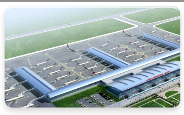 ANGOLA: Government to spend EUR1.6billion on aviation infrastructure by 2016. The Angolan government, by 2016, will have invested EUR1.6billion into the construction and rehabilitation of thirty domestic airports, including sixteen new ones, Manuel Ferreira de Ceita, the CEO of Angola's airport and air traffic authority (Empresa Nacional de Aeroportos e Navegação Aérea - ENANA), has said. In his remarks at the recently ended 4th China & Lusophone Countries Airport Conference in Macau, Mr Ceita said the investment in infrastructure was in line with ENANA's long term vision. Since January 2009, ENANA has been working on the construction, rehabilitation and upgrading of more than 30 airports and runways countrywide. New airports that have opened include those in Huambo, Cuito Cuanavale, Soyo (Zaire Province), Uige, Dundo (Lunda Norte Province), Saurimo (Lunda Sul Province) and Luena (Moxico Province). Angola International Airport Among the biggest of the projects though is the construction of Luanda's new Angola International Airport being undertaken by a consortium of Chinese companies and Brazilian company, Odebrecht. The facility will entail a terminal building 160,000m² in area with a throughput capacity of up to 13.152 million pax/annum, and a 6,200m² cargo terminal capable of handling 35,000 tonnes per year. ANGOP reports Ceita as saying the development of the aviation sector in Angola has an important basis in cooperation with Portugal, notably with the Portugal's air navigation services provider (Navegação Aérea de Portugal – NAV) which "has accumulated experience and extensive knowledge to spread throughout the world." by Ivan Nadalet News Fea ture ture
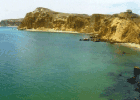
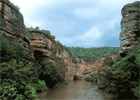
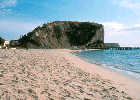
ANGOLA‚"GETTING BACK ON THE TOURISM PATH" by Helen C. Broadus Angola is rapidly becoming a must see tourism destination with the advent of peace and stability returning to this African country. This beautiful country is located on the west coast of sub-Saharan Africa, between the Equator and the Tropic of Cancer. Its neighbors are the Democratic Republic of the Congo to the north, Zambia to the east and Namibia to the south. Angola is believed to have derived its current name from the kingdom of Ndongo which was ruled by chiefs known as ‚"úngola‚". Since its independence from Portuguese in 1975 it had suffered severe social and political unrest as a result of a prolonged civil war. Despite its past history, it is very good to know that Angola has managed to regroup and is well on its way towards getting back on the tourism trail. | Photo Captions - Top: Cliffs north of the fishing village of Porto Amboim
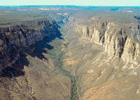
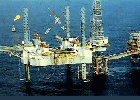
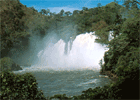
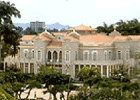
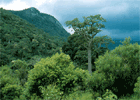
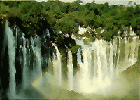
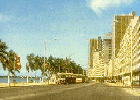
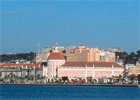
Left column: Coastal foothills: Hotel Le Presidente, Luanda;International airlines serve Angola; Benguela Bay; Nature's Wonder; Oil and Gas fuel Angola's economy; Angola lifestyle; Keve River Waterfalls;
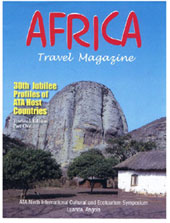
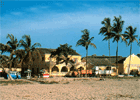
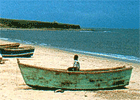
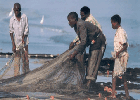
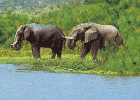
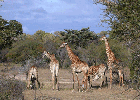
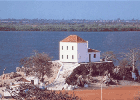
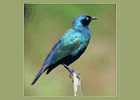
Right column: South of Sumbe, traditional fishing boats on beach near the mouth of the Cubal River; Sunrise on Luanda Bay; Luanda by day; Luanda by night; Boys fishing in Luanda Bay; Beach at Porto Amboim; Wildlife- elephants; Wildlife- giraffes; Harbor scene; Birding is popular here; Another view of the falls.Photos courtesy Infotur, Angola Miistry of Tourism. |  In fact, Angola will be hosting the Africa Travel Association's (ATA) Ninth Eco-Tourism Symposium from October 30th through November 4th, 2005. This will be the first time that such a major travel and tourism event will be held in Angola, and there will be daily seminars and workshops on the travel and tourism industry; gala luncheons and evening banquets with cultural entertainment; and plenty of sightseeing and shopping opportunities. In fact, Angola will be hosting the Africa Travel Association's (ATA) Ninth Eco-Tourism Symposium from October 30th through November 4th, 2005. This will be the first time that such a major travel and tourism event will be held in Angola, and there will be daily seminars and workshops on the travel and tourism industry; gala luncheons and evening banquets with cultural entertainment; and plenty of sightseeing and shopping opportunities.
The ATA is an international, nonprofit, nonpolitical and educational organization established in 1975 to promote the travel and tourism industry of the Continent of Africa. Its membership is comprised of African government tourist offices, international airlines, hotels and resorts, cruise lines, tour operators, travel agents, tourism educators and public relations/marketing firms. For more information about the Africa Travel Association or the Ninth Eco-Tourism Symposium in Angola, please visit their website at www.africa-ata.org. Rich in oil and diamonds and other natural resources, Angola is a sparsely populated country roughly the combined size of Texas and California. Most of the country is bisected with heavily-wooded hilly and mountainous terrain situated in the north and dry bush and desert terrain situated in the south. The country has a tropical climate, a rich and varied wildlife and most of all warm and friendly people. Portuguese is the official business language as well as international language. There are an additional six other national languages spoken: Kikongo, Kimbundo, Umbundu, Chokwe, Mbunda and Oxikuanyama. The population of Angola is an estimated ten million of which the Bantu-speaking people are in the majority with fifty-three percent of the population Christians (mostly Roman Catholics) and the remainder adhering to indigenous beliefs. Accordingly, the ‚"Ten Best Reasons to Visit Angola‚" are: ( a) the capital city of Luanda which is a vibrant tourist venue; (b) historic reminders of the colonial past; (c) a thriving tribal culture with many traditions; (d) a tropical climate with year-round pleasant weather; ( e) the opportunity to view wildlife in unique and unfrequented national parks; (f) splendid landscapes including rivers, jungles and mountains; (g) a unique heritage of traditional art; (h) plenty of water sports in Luanda and nearby towns; ( i) the erotic, Angolan "masemba‚" dance performed by local dancers; and (j) traditional Angolan cuisine with a strong Portuguese influence. In addition, local arts and crafts can be purchased in many marketplaces in Angola. Items made from ebony, rosewood, straw, malachite, bronze and pottery are all available. A wide variety of wooden masks and traditional instruments such as marimbas kissanges, xingufos, ankle rattles and drums can also be purchased.  ....... ....... 
Interesting Places to Visit while in Angola include the following: Luanda the capital city of Angola, which was founded in 1575 by the Portuguese explorer Paulo Dias de Novais, retains its heritage as a Portuguese colonial city and there are several interesting buildings of historical significance and a number of churches that date back to the 17th century. Luanda is divided into two parts, the ‚"baxia‚" or old part and the ‚"cidade alta‚" or new part. One of the city's most famous landmarks is the Armed Forces Museum, which is housed in the St. Miguel Fort. The National Bank of Angola building, a large pink colonial building overlooking the palm fringed bay, which is another example of the legacy of Portuguese architecture as is the Kinaxixi market building. Ilha de Luanda, originally an island, has been joined to the mainland by a causeway. There, one will find many discotheques, bars and casinos, as well as restaurants where national dishes such as palm oil beans, fish calulu, dried meat, corn funge, chicken muamba and mufete de cacuso (tilapia) farofa can be truly savored. Other attractions include the Mussulo Peninsula with its three islets, the largest of which is called the Island of Priest. Further south, tourist can visit the Slavery Museum, housed at the site where slaves were kept while waiting to be taken to Brazil in the Americas. The Kwanza River mouth nearby is a beautiful spot for picnics and fishing. Kuando Kubango Province, situated in the far southeastern area of Angola, bordering Zambia and Namibia, it is the country's second largest province. Blessed with two great rivers, the Kuando and the Kubango, the province forms the gateway to the rest of southern Africa and certainly has tremendous potential to become the hub for cross-border trade and tourism opportunities. The climate is pleasantly tropical and dry and the land is rich in many untapped resources such as timber, diamonds, gold and copper. Namibe Province: Bordered by the Atlantic Ocean to the west and Namibia to the south, this province is the land of the Welwitschia mirabilis, an astonishing desert plant that resembles a giant octopus! This plant, which spans 2m to 3m in diameter, is unique to the region and is carnivorous! The Namib Desert itself offers excellent hunting and attracts game hunters from southern Africa and overseas. With the third largest port in the country, Namibe Province is one of the main centers of fishing. The province also has very beautiful beaches, with facilities for water sports and other activities. One of the most attractive spots is Bibala Beach, where the water is said to have healing properties. Kwanza Norte ‚Äì which is well known for its mighty rivers, it is covered by dense tropical forest in the north and savannah in the south. The Capanda Dam, situated in the middle of the Kwanza River, is a hydro-electric power source and one of the largest civil engineering projects in the country. Kwanza Sul Province ‚ which is bordered by the Bengo, Kwanza Norte and Malange Provinces in the north, Brie to the east, Benguela and Huambo to the south and the Atlantic Ocean to the west. The main tourist attractions in the province include the waterfalls, thermal springs and caves. The port, Porto Amboim, is the major access by sea. Lunda Norte and Lunda Sul; this province is famous for its art and vast reserves of diamonds and was once part of a powerful ancient kingdom known as Tchokwe. The kingdom straddled what are now northeast Angola and the southwestern part of the Democratic Republic of the Congo. Today, Tchokwe sculptures are still popular with art collectors; one of the most famous being O Pensador, a graceful sculpture of a philosopher resting his head in his hands. Bunguela Province ‚Äì whose main attraction is the city of Benguela, known locally as Crimson Acacia. The province has superb beaches, including Kaota, Kaotinha, Baia, Azul and Baia Farta. Scuba diving and deep sea fishing are very popular pastimes. Huambo Province ‚ with its stunning colonial style buildings has long been the center of Angolan history. This province has a pleasant climate and rich, fertile soil that lends itself to much cultivation. Zaire Province; along with its neighboring province of Uige, Zaire was once part of the Kongo Kingdom. The heartland of the kingdom encompassed Mbanza Kongo, the present day capital of the province. The royal court was based in the town, which was the center for trade and other political and economic activities. The province has vast offshore oil reserves and plays host to a large number of oil companies. The place where the Congo River meets the sea is one of the most moving sights in the country and a trip to the ‚"Point‚" will take one to the site where the great explorer, Sir Henry Morton Stanley started his historic trip into the heart of Africa in search of the famous Dr. David Livingstone. Cabinda Province; the Cabindans have a very rich cultural tradition and still practice Bantu rituals, such as initiation ceremonies. The province's most impressive attraction is the Maiombe Rainforest, which is especially famous for its butterflies. There are hundreds of species of butterflies to be found in the forest, many of which are unique to the area. Prized by collectors, specimens of these butterflies can be found in natural history museums throughout the world. Travel Details: The climate in Angola varies depending on the altitude. The dry season is between May and October with the rain beginning from November and December until April. The warmest months are September and October, while July and August are the coolest. Lightweight casual wear is appropriate throughout the year, although jackets and jerseys are advisable for the evenings as it can get cold at night. Rainwear is definitely recommended during the rainy season. It is generally advisable to consult with your health care practitioner for precautionary measures against tropical disease before traveling to Angola. Medication against malaria is strongly recommended and it is also advisable to have a yellow fever vaccination. The local currency is the Kwanza (Kzr) which is named after one of the larger rivers in Angola and U.S. dollars are widely accepted. Visas are required for American citizens and all visitors must have a valid passport and proof of return tickets. While most European airlines provide transport to Angola you should always consult with your travel agent for specific travel and tourism assistance as many hotels have recently undergone refurbishments in Luanda. For more information about visiting Angola, please contact the Embassy of Angola in Washington, D.C. at telephone: (202) 785-1156 or facsimile at (202) 822-9049 and the mailing address is 2108 Sixteenth Street, Washington, D.C. 20009. You can also visit the following website: http://www.angola.org. About the author: Helen C. Broadus is the President of Venue International Professionals, Inc. (VIP) which is an African-American owned, full-service travel and tourism company based in the Washington Metropolitan Area specializing in travel and tourism destinations to the Continent of Africa. For more information about VIP or to discuss travel and tour arrangements for visiting Angola, please contact VIP at 1-877-TO-VENUE [TOLL FREE]; (301) 856-9188 [VOICE]; (301) 868-2218 [FAX]; vipinc@erols.com [E-MAIL]; and also visit VIP's website at www.venuetravel.com. |