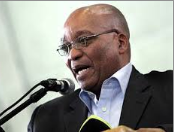
President of the Republic of South Africa
Jacob Gedleyihlekisa Zuma was born in 1942 in Inkandla, KwaZulu
Natal to Gcinamazwi and Nokubhekisisa Zuma.
Forced by circumstance to educate himself - his father had died
and his mother could not afford to pay for formal schooling - he
established an informal school in his village.
Influenced by a trade unionist family member, he became involved
in politics at an early age, joining the ANC in 1958. He became
an active member of the ANC's armed wing, Umkhonto we Sizwe, in
1962, following the banning of the ANC in 1960.
While on his way out of the country in 1963, he was arrested
with a group of 52 recruits near Zeerust, and sentenced to 10
years' imprisonment, which he served on Robben Island. After his
release, Zuma helped mobilise internal resistance and was
instrumental in the re-establishment of ANC underground
structures in the then Natal between 1974 and 1975.
He left South Africa in December 1975 and for the next 12 years
was based in Southern Africa, first in Swaziland and then
Mozambique. During this period he was involved in underground
work with former President Thabo Mbeki and others, giving
leadership to ANC structures operating inside South Africa.
He also dealt with the thousands of young exiles that poured out
of South Africa in the wake of the Soweto uprising in June 1976.
He became a member of the ANC National Executive Committee (NEC)
in 1977. By the end of the 1980s he was head of the ANC
Intelligence Department. He became widely known in this critical
position at a time when the ANC had the difficult task of
protecting the organisation from infiltration and to ensure its
survival.
Following the unbanning of the ANC in February 1990, he was one
of the first ANC leaders to return to South Africa to begin the
process of negotiations with the then apartheid regime. Like
other leaders involved in talks he had to convince the ANC
membership and support base of the need to negotiate with an
apartheid regime that was intent on maintaining its power and
influence.
He was instrumental in organising the Groote-Schuur Minute
between the De Klerk government and the ANC that reached
important decisions about the return of exiles and the release
of political prisoners.
His strategic thinking and conflict resolution skills played a
pivotal role in ending conflict in KwaZulu Natal and the then
PWV region, where state-sponsored violence was tearing
communities apart.
In 1991, at the first ANC conference held in South Africa since
1959, he was elected Deputy Secretary General.
After the 1994 elections, Zuma requested to be deployed to
KwaZulu Natal to work to cement peace between the ANC and
Inkatha Freedom Party (IFP).
He joined the provincial government as MEC of Economic Affairs
and Tourism. He played an instrumental role in normalising
relations within the multiparty government of the ANC and IFP.
As MEC Zuma worked hard to develop the tourism industry in the
province and was highly regarded by the sector. He created a
good working relationship between business and labour, and
worked tirelessly to facilitate new investments into the KwaZulu
Natal economy.
In December 1994, he was elected ANC National Chairperson. An
exception was made in the ANC Constitution to allow him to serve
as both provincial chairperson and National Chairperson.
Zuma was elected ANC Deputy President in December 1997.
He served as Deputy President of South Africa from 1999 until
June 2005.
During his tenure he distinguished himself in his role as
mediator and facilitator of peace on the continent, especially
in Burundi and the Democratic Republic of Congo (DRC).
As Leader of Government Business, he worked to ensure good
working relations between government and political parties in
Parliament, and between Parliament and the Executive.
He kick-started the process of promoting positive values through
the launch of the Moral Regeneration Movement.
In 1998 he established the Jacob Zuma RDP Educational Trust
Fund. The fund has educated more than 20,000 children at primary
school level to university. Beneficiaries are primarily from
impoverished backgrounds in rural areas.
Zuma was elected ANC President in December 2007, becoming the
ANC's candidate for South African president in the 2009
elections.
He loves sports especially soccer and rugby and was a keen
soccer player in his youth. He dabbled in ballroom dancing on
Robben Island. South Africans know and love him for his prowess
on the dance floor and his impeccable vocal chords.
Zuma has received several awards, including the Nelson Mandela
Award for Outstanding Leadership in Washington DC, US (1998),
and honorary doctorates from University of Fort Hare, University
of Zululand, Medical University of Southern Africa, University
of Limpopo (2001), University of Zambia (2009), American
University of Nigeria, University of Abomey-Calavi of Benin
(2011),Texas Southern University (2011) and Honorary
Professorship from the Peking University (PKU) of the People’s
Republic of China (2012).
He was elected President of the Republic of South Africa on 6
May 2009. He was inaugurated at the Union Buildings in Pretoria
on 9 May 2009.



 ..
..