     |
|
EGYPTIAN TOURISM'S MESSAGE TO WORLD: COME
ANYWAY
W HOTELS WORLDWIDE TO DEBUT
IN EGYPT WITH W SHARM EL SHEIKH AND THE RESIDENCES AT W SHARM EL
SHEIKH
Oct 8,2015
NEW YORK, Oct 08, 2015 -- Starwood Hotels & Resorts Worldwide, Inc. HOT, -0.27% today announced that it will launch the iconic W Hotels brand in Egypt in 2020 with the opening of W Sharm El Sheikh and The Residences at W Sharm El Sheikh. Owned by Tower Prestige for Hotels SAE, the hotel will be ideally located at pristine Nabq Bay in the resort town of Sharm El Sheikh. Known to be one of the finest diving spots in the world, Sharm El Sheikh is amongst the most famous leisure spots in the Middle East. “Starwood’s lifestyle brands are gaining traction with developers and guests in Africa. We are excited to build a long-term relationship with Tower Prestige for Hotels SAE to bring W Hotels and its dynamic DNA to the Red Sea and are confident that W Sharm El Sheikh will become the number one choice for design-conscious local and international guests in the region,” said Michael Wale, President, Starwood Hotels & Resorts, Europe, Africa and Middle East. “Not only does this signing underline our continued commitment to expand the W brand’s footprint in resort destinations, it also reinforces our leadership position in Egypt where we operate 11 Starwood hotels and have another three under development.” “We are delighted to be working with Starwood Hotels & Resorts on this exciting and ground-breaking project,” said Mohamed Gamal Abdelwahab Omar, CEO, Tower Prestige for Hotels SAE. “We believe that W Hotels, with its outstanding international reputation as an innovative lifestyle brand, will reinforce the importance of Sharm El Sheikh as a world-class destination.” W Sharm El Sheikh will ignite the local resort scene with its electrifying style and full calendar of exclusive W Happenings, showcasing the latest in fashion, music and design. The hotel will offer 350 stylish guest rooms and suites, including two Extreme WOW Suites (the W brand’s interpretation of the Presidential Suite). The Residences at W Sharm El Sheikh will feature50 branded residences with an exclusive lounge. Residents will enjoy access to the facilities and services that are available at the hotel. Facilities at the hotel will include an all-day dining venue, two specialty restaurants, a destination bar and W Lounge (the W brand’s take on the traditional hotel lobby). Other amenities will include a spa, FITTM state-of-the-art fitness facility, a tennis court, WIRED 24-hour business centre, and a glamorous outdoor pool deck and bar. Guests can also expect the W brand’s signature Whatever/Whenever® service, providing guests whatever they want, whenever they want it. An ideal venue, W Sharm El Sheikh will offer more than 1,880 square metres of ultra-modern meeting and event space, including a great room for larger celebrations and six Studios for smaller meetings. For more information, please visit www.whotels.com. SOURCE: Starwood Hotels & Resorts Worldwide, Inc.Starwood Hotels and Resorts
Anjali Mehra,
+971565396555
|
.png)
.png)
|
|
|
From Egypt: King Tut
Exhibit returns to USA From atop the
Cairo Tower, the mighty Nile appears to be
overwhelmed by the edging luxury hotels and
towering apartment buildings. Beyond, the city with
its crowded streets, literally infested with
humanity, spreads out to the horizon. In between
the avenues with their mass of darting autos, one
sees a thousand minarets of new and historic
mosques, peppered with a number of Coptic-Christian
basilicas. It appears to be an inviting city to
explore - a mixture of eastern exoticism and
Western sophistication. Yet, this is not
what the millions of people traveling to Egypt want
to see. If one turns atop the Tower to the other
side, in the distance, a visitor glimpses the
outline of the Great Pyramids. Located on a desert
plateau on the western edge of the city, they are
the magnets that draw these tourists. It is as if
the pharaohs of Ancient Egypt are still caring for
their descendants. Of the millions of tourists who
travel to Egypt, the vast majority come to view the
monumental vestiges left by one of the greatest
civilizations the world has ever
known.
Mr. Ahmed El-Khadem, Chairman of the Egyptian
Tourist Authority, Sandy Dhuyvetter, Executive
Producer and Host of TravelTalkRADIO and TV, and
Mr. Ayden Nour, Director of North and South
American Office for Egyptian Tourist Authority
Giza
Pyramids -
to distinguish them from the other 108 pyramids in
the country, they are approached by a wide-straight
road built in the 19th century by the Empress
Eugénie, the wife of Napoleon III. She came
during the inauguration of the Suez Canal and in
order to see the pyramids, the empress constructed
this avenue called Al-Ahram - in Arabic meaning
'the pyramids'. Giza Pyramids of Cheops,
Chephren and
Mykerinos
Once these pyramids
and others played a vital role in the lives of
Egypt's kings and peasants. Today, for many, they
are the trademark of lasting power, drawing, from
across the globe, tourists and those who dabble in
magic and the extraterrestrial. Watching haughtily
over the pyramids is the nearby famous Sphinx,
carved out of solid natural rock by Chephren the
son of Cheops, the builder of the second pyramid.
He had this huge statue sculptured from soft
limestone with a lion's body, and a god's face -
believed to be his own. For over 45 centuries, it
has defied time, witnessing all the morning suns
civilized man has seen. Carved in the midst of
temples, which are in the process of being
excavated, this half man half beast statue has
acquired, through the centuries, an air of mystery
and romance. The magnificence of
the pyramids and the Sphinx are superbly portrayed
in the 'Sound and Light' shows, presented nightly.
After sunset throughout the year, on different
nights, in Arabic, English, French and German,
these shows, the finest of their kind presented
anywhere, draw droves of tourists. They add much to
the appreciation of the Giza phaorononic monuments
and their history. Egyptian Museum of
Antiquities However, the museum
has long become too small for its ever-increasing
collections and a modern and larger one is in the
works. Nevertheless, this too will likely be not
spacious enough after it is completed. The untold
thousands of pieces of one of the oldest and
grandest civilizations on earth can easily fill
half a dozen museums. After this
storehouse of priceless ancient treasures, one
becomes eager to explore the boundless pharaonic
monuments around Luxor and Aswan where, it is said,
half of the world's important ruins are to be
found. The Egyptian Museum of Antiquities in Cairo
is the best door through which tourists can enter
into this heart of the pharaonic
history. Nile cruise from
Luxor to Aswan The city's most
important monument, the Karnak Temple, dedicated to
the god Amon-Ra, was for the ancient Egyptians, a
highly esteemed place. Covering over 40.5 ha (100
ac) and spanning thirteen centuries, the complex is
a massive collection of ruins on which at one time
81,000 people toiled - the largest series of
temples ever built in one complex. In both the
Karnak and Luxor Temples, imagination overtakes
eyesight, as thousands upon thousands of these
visitors take a thrilling walk through history.
Beneath pillars carved with lotus buds and the
papyrus plant, past statues of gods and animals,
and climbing down into fantastically decorated
tombs, they are never far away from the early
Egyptians and their remains. From Luxor the ship
stops at Esna - 64 km (40 mi) to the south. Its
temple, dedicated to Khnun, the ram-headed god who
modeled people on his potter's wheel, is a
Ptolemaic building with Pharaonic, Greek, Roman and
Coptic elements. At one time, the Temple was
completely concealed with debris and sand. This
kept the hypostyle hall with its forest of 24
columns, 13 m (43 ft) high, topped by capitals of
flowers and plants, in almost perfect
condition. The next stop,
Edfu, 123 km (76 mi) north of Aswan, has the best
preserved of Egypt's 100 temples which were built
to honor some 750 gods. The sand that for centuries
had covered the temple and was responsible for its
preservation. Dedicated to the falcon-headed god,
Horus, the most famous deity in Upper Egypt, it is
covered inside and out, with mythological and
religious decorations, bas-reliefs and hieroglyphic
texts. Before reaching
Aswan the ship stops at the Temple of Kom Ombo,
dedicated to Sobek, the crocodile god of fertility,
and Haroeris, the Good Doctor. Built a few
centuries before the Romans occupied Egypt, the
temple also served as a hospital - a whole series
of medical instruments are sculptured in reliefs on
the temple walls. At Aswan, the
Philae Temple and, to the south, the Temple of Abu
Simbel, both moved due to the waters of the High
Dam, draw annually thousands of visitors. From
Cairo to Aswan and beyond, these, and the dozens of
other temples, especially after peace has returned
to the Nile Valley, are again enticing tourists in
the millions. With the foreign exchange these
Ancient Egyptian monuments bring, there can be
little doubt that the god-king pharaohs are lending
a helping hand in the life of modern Egypt. Egypt: How to
Get There: If one does not
join a tour group, Misr Travel in Egypt, 1 Talaat
Harb St., P.O. Box 1000, Cairo, Tel: 20-2-392-3177,
Fax: 20-2-392-4440, e-mail Misrtrav@link.com.eg
will make arrangements for tours to any part of the
country. Also, there are excellent river, air, bus
and rail connections between Cairo and
Luxor. Facts to Know
About Egypt: 2) The best place
to exchange foreign currency is in banks. Branches
are found in all major hotels. The U.S. dollar
hovers around 3.80 LE (Egyptian pounds). 3) Despite reports
of Islamic fundamentalist terrorism, Egyptians are
very friendly and hospitable to tourists. The
country is very safe - safer than most countries in
the West. Also, in spite of poverty, crime is
rare. 4) To get around
the cities, taxis are the best bet, but you must
bargain - make sure of the price before you enter
the cab. Small autos rent for around $40. per day,
but renting a car is not recommended. Traffic does
not seem to have any rules. A Good Place to
Stay in Aswan: For Further
Information Contact: or
Egyptian Tourist Authority, 630 Fifth Ave.,
Suite 1706, New York, NY 10111, U.S.A. Tel:
(212)332-2570. Fax: (212)956-6439. 1) Great
Sphinx of Giza (2) Gold Mask of Tutankhamun
EGYPT'S DR. ZAHI HAWASS
NAMED 2008 WORLD TOURISM AWARD HONOREES AT
CORINTHIA HOTELS PRESS BREAKFAST Tony Potter, CEO
and managing director, CHI The World Tourism
Award inaugurated in 1997 and celebrating its 11th
Anniversary, was established to recognize "the
extraordinary initiatives by individuals,
companies, organizations, destinations and
attractions for outstanding accomplishments in the
travel industry." The Ceremony itself will
take place on Tuesday, November 11, 2008 at Excel
Centre, London. The 2008 Honorees
are being recognized for their dedication to the
preservation of natural and cultural heritage, one
as an organization and the other as an individual.
The first Award will honour UNESCO World
Heritage Centre, in rrecognition of
"its outstanding guidance, support
and encouragement to 185 countries around the world
by establishing and monitoring 878 World Heritage
Sites that will protect and preserve their
irreplaceable natural and cultural heritage for the
future of all the people of the
world." The Second
Award will honour Dr. Zahi Hawass, Secretary
General, Egypt's Supreme Council of
Antiquities, in recognition of "his dynamic
and committed leadership,
in developing and implementing,
innovative management plans to care for and protect
Egypt's world famous ancient attractions,
including several UNESCO World Heritage
Sites." |
|||

 Champollion\was
a French classical scholar, philologist and
orientalist
Champollion\was
a French classical scholar, philologist and
orientalist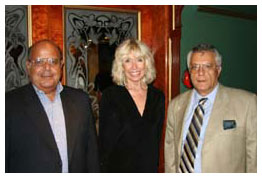 Click
for radio
interview
Click
for radio
interview Pyramids
and Sphinx, World's Enduring
Monuments
Pyramids
and Sphinx, World's Enduring
Monuments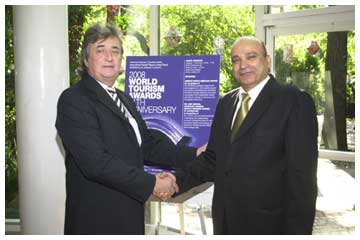 Hotels
& Resorts, the management company for Corinthia
Hotels, announced that UNESCO World Heritage Centre
and Dr. Zahi Hawass, Secretary General, Egypt's
Supreme Council on Antiquities, are the 2008 World
Tourism Award Honorees. Corinthia Hotels, together
with American Express, International Herald Tribune
and Reed Travel Exhibitions, co-sponsor this
prestigious Award presented annually at World
Travel Market in London. This announcement
was made at a Corinthia Hotels Press Breakfast at
Tavern on the Green in New York City.
Hotels
& Resorts, the management company for Corinthia
Hotels, announced that UNESCO World Heritage Centre
and Dr. Zahi Hawass, Secretary General, Egypt's
Supreme Council on Antiquities, are the 2008 World
Tourism Award Honorees. Corinthia Hotels, together
with American Express, International Herald Tribune
and Reed Travel Exhibitions, co-sponsor this
prestigious Award presented annually at World
Travel Market in London. This announcement
was made at a Corinthia Hotels Press Breakfast at
Tavern on the Green in New York City.