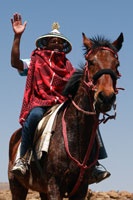
LESOTHO
Welcome TO THE KINGDOM IN THE SKY
Lesotho is a democratic, sovereign and
independent country which has an unusual distinction of
being completely surrounded by another country, the republic
of South Africa. The Kingdom of Lesotho is one of the three
remaining monarchies in Africa.
Situated between 28 and 31 degrees South and
between 27 and 30 degrees East, Lesotho lies entirely
outside the tropics, at a considerable height above sea
level, and is thus bilharzias and malaria free destination.
It has a land area of approximately 30, 555
km2,
making it similar in size to Belgium or a little larger than
American State of Maryland in USA.
A land of mountains, Lesotho is the only
country in the world which has all its land lying at
altitudes in excess of 1500m above sea-level; it is a land
of heights and extremes. The mountain, Thabana-Ntlenyana is,
at 3,482m, the highest in Southern Africa, while the highest
single drop fall in the Southern Africa Maletsunyane is
192m, having the highest abseiling cliff in the whole world
at 204m.
Often referred to as the "Switzerland of
Africa", it is blessed with a beautiful, often a snow-capped
range of mountains, the Maluti. The kingdom's central
position in the heart of Africa's most developed economy of
South Africa, is well served by air, rail and road links to
all its major commercial centres.
Lesotho is only one hour by air or four hours
by road from Johannesburg in the Republic of South Africa.
The Kingdom is a home to the largest and most
ambitious civil engineering project in the whole of Africa,
Lesotho Highlands Water Project (LHWP), which has harnessed
and commercialized her up-stream surplus water sources -
often referred to by Basotho as their "White Gold".
Tourist Attractions in Lesotho
Sehlabathebe National Park
Sehlabathebe National Park is the national
designated nature reserve in Lesotho and comprises 6
500 hectares at an average elevation of 2 400 m. The
park is ideal for hiking, bird-watching and contains
unusual rock formations and alpine flora. Game is
limited to a few antelope species but the scenery is
stunning.
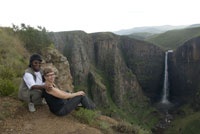 Maletsunyane
Waterfalls, one of the highest single dropping
waterfalls in the Southern Hemisphere plummeting 186
metres into a spectacular gorge creating clouds of
spray visible from afar Semonkong Lodge offers you
the chance to explore the magnificent scenery and
culture of Lesotho The Lodge together with the local
community provides ponies and guides for the
adventure, day trips to the Maletsunyane Fall.
Maletsunyane
Waterfalls, one of the highest single dropping
waterfalls in the Southern Hemisphere plummeting 186
metres into a spectacular gorge creating clouds of
spray visible from afar Semonkong Lodge offers you
the chance to explore the magnificent scenery and
culture of Lesotho The Lodge together with the local
community provides ponies and guides for the
adventure, day trips to the Maletsunyane Fall.
Thaba Bosiu Mountain
Thaba Bosiu, The name Thaba Bosiu means
the 'Mountain at Night'. It was in July,1824 when
Moshoeshoe and his people took occupation of the
mountain which his brother Mohale had reconnoitred. He
named the mountain Thaba Bosiu-Mountain at Night because
he and his people arrived there in the evening and the
essential protective work took him until late at night.
Many years later the news to intimidate his enemies was
spread that at night time the mountain grew larger than
usual.
The mountain is flat-topped and it is situated in the
valley of the Phuthiatsana River. It is about fifteen
miles east of the junction of this river with Mohokare
or Caledon that divides Lesotho from the Free State. It
rises about 350 ft. from the surrounding valley and its
summit is surrounded by a belt of perpendicular cliffs
some 40 ft. high on the average.
Tse'hlanyane National Park
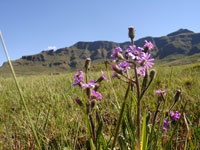 Tse'hlanyane
National Park, is located deep in the front range of the
Maluti mountains, with headquarters at the foot of the
Holomo Pass. The reserve owes its origin to the access
road to the Hlotse tunnel adit for the Lesotho Highlands
Water Project (LHWP). This protected area lies at the
junction of the Tse'hlanyane and the Holomo rivers.
Tse'hlanyane
National Park, is located deep in the front range of the
Maluti mountains, with headquarters at the foot of the
Holomo Pass. The reserve owes its origin to the access
road to the Hlotse tunnel adit for the Lesotho Highlands
Water Project (LHWP). This protected area lies at the
junction of the Tse'hlanyane and the Holomo rivers.
Over 5600 hectares of extremely rugged mountains terrain
is protected within this park, which includes one of the
very few indigenous woodlands in Lesotho. The reserve
also encompasses a reasonable proportion of mountain
lsquo;fynbos' with a high degree of endemism.
The park is reached by a 32km-gravel access road that
leaves the main A1 route 8 km south of Butha Buthe. The
route passes through the village of Khabo's and
parallels the Hlotse River along a very picturesque
valley until it reaches the park entrance.
Liphofung Nature Reserve
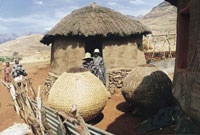 Liphofung
Nature Reserve, "place of the eland" cave occupies an
important place in Lesotho history. This is the smallest
of the Lesotho Highlands Development Authority reserves
at about 4 hectares. The cave is in fact a large
overhang in the Clarens sandstones, which is a typical
feature of the Lesotho lowlands region.
Liphofung
Nature Reserve, "place of the eland" cave occupies an
important place in Lesotho history. This is the smallest
of the Lesotho Highlands Development Authority reserves
at about 4 hectares. The cave is in fact a large
overhang in the Clarens sandstones, which is a typical
feature of the Lesotho lowlands region.
This is particular site lies in a tributary stream
valley of the Hololo River just off the main route from
Butha Buthe to Oxbow and Mokhotlong. Access is by means
of a newly constructed concrete road and is passable for
all vehicles. A small visitor's centre incorporating a
display of Basotho culture and San rock art has been
developed, along with ablution facilities and a small
shop. The site is proving to be a popular destination
with school groups and tourists en route to Oxbow.
Lesotho Highlands
Snow skiing is possible on the slopes
below the Mahlasela Pass; New Oxbow Lodge nearby and
Afri Ski rents skis and boots. There are three slopes
and two ski lifts, while several alternative activities
are on hand in the summer months. The resort of Afri-Ski
is 4 frac12; hours' drive from Johannesburg South Africa
via the steep tarred Moteng pass and the Mahlasela pass
and is one of only two skiing resorts in Africa.

 .
.
 .
.