|
|
|
|
|
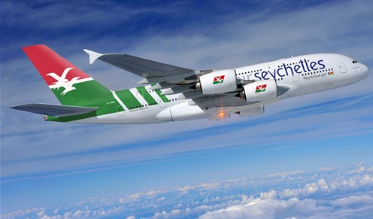
Air Seychelles is
the national airline of the Republic of Seychelles,
with its base at Seychelles
International Airport.
The carrier operates regional, inter-island services
as well asinternational
services to South
Africa, Europe and Singapore.
Air Seychelles was wholly-owned by the Seychelles
government, until Etihad purchased
a 40% stake in it in Jan-2012.
.png)
It is a great pleasure that we announce that Air Seychelles, the national
airline of the Republic of Seychelles, has scooped two coveted accolades at
the World Travel Awards 2014, further enhancing its status as the leading
carrier in the Indian Ocean region and beyond.
The airline was awarded Indian Ocean’s Leading Airline – Business Class and
Indian Ocean’s Leading Cabin Crew.
In addition, the carrier has re-started its flagship Paris route, revamped
cargo handling facilities at Mahé airport, launched a new weekly
inter-island domestic cargo service, and given indications it is on course
for a third year of profitability.
AIR SEYCHELLES MAKES IT TO
SKYTRAX PODIUM POSITION

The turnaround at Air Seychelles, manifested
through a million US Dollar profit after not
much more than a year of partnership with Etihad,
Abu Dhabi’s national airline, and marked by a
rush of code share arrangements which now sees
the HM code carried to more destinations than
the ‘old’
Air Seychelles could ever reach, has continued
after the results of this year’s Skytrax passenger
survey has come to light.
More than 18 million passengers from around the
world voted for excellence in the skies and lo
and behold, Air Seychelles has made it to a
podium finish.
Air Seychelles is now ranked as Africa’s second
best airline, up by 8 places from last year’s
10th overall position in this category, and the
airline’s staff is now ranked as the third best
in Africa.
In the ‘most improved’ category Air Seychelles
came in fourth, and the airline’s global
standing is now position 56, up from number 133
in 2012.
Cramer Ball, Air Seychelles’ CEO, received the
news with obvious delight and had this to say: ‘This
is a significant achievement for Air Seychelles
and further confirmation that the airline is
moving in the right direction. To climb so
quickly in the Skytrax rankings in such a short
time is evidence of our team’s determination to
be the best airline in the Indian Ocean and to
fulfill Air Seychelles’ vision to be a high
quality, profitable airline. The
Global Airline Awards are based on traveller
feedback, so it is pleasing to see that our
customers are recognising the rapid progress we
are making towards being the best airline in the
region. The results demonstrate our commitment
to training, our investment in our people and
our product and further demonstrates the value
of our partnership with Etihad Airways’.
The results will no doubt assist to further
underscore the archipelago’s relentless drive to
portray the Seychelles as a dream destination in
the deep of the Indian Ocean, an experience
which can now start as soon as passengers board
an Air Seychelles flight from Hong Kong, Abu
Dhabi, Johannesburg or Mauritius – and, not to
forget, when flying across to Praslin island on
one of the nearly 20 daily services from Mahe.
Watch this space for regular and breaking news
from the Indian Ocean region’s vibrant aviation
sector.
TRAVELTALKRADIO OF THE USA
EXPLORES THE SEYCHELLES CARNIVAL THROUGH A LIVE
INTERVIEW WITH ALAIN St.ANGE, THE SEYCHELLES MINISTER
FOR TOURISM AND CULTURE
The campaign for the 2013 Carnaval
International de Victoria has hit the United
States of America (USA) and listeners of
TravelTalkRadio – USA.
It was the voice of Alain St.Ange, the
Seychelles Minister for Tourism and Culture, who
was the guest star on the talk show,
TravelTalkRadio, hosted by Sandy Dhuyvetter. The
talk show recently moved on their new generation
of Internet radio station dissecting a number of
niche topics on Seychelles’ diversity of
culture, food, and most importantly the
Seychelles Carnival. In the fifteen minutes and
45 seconds airplay, the Seychelles Minister
St.Ange accentuated on the exquisite information
about the Carnival to listeners. Minister
St.Ange explained that Seychelles’ carnival is
opened to the world to showcase their own
culture and above all their people.
“Seychelles’ Carnival is unique in its own way.
It is the only carnival that brings together the
world’s best carnivals and the best cultural
groups from the Community of Nations from around
the world. They all rallied together walking
side by side. This is why it is called the
‘carnival of carnivals’ that is staged under the
tagline of the melting pot of cultures. We
believe that Seychelles can offer to the world
the opportunity to showcase their culture as
they fly their flag as high as possible in the
world’s smallest capital,” said Minister St.Ange
Through this latest radio interview, words about
the Seychelles Carnival that will be held from
February 8-10, 2013 reached worldwide listeners
and in so doing boosts the Seychelles’ image as
an event-based destination. Minister St.Ange’s
interview with TravelTalkRadio was the
opportunity for the Minister responsible for
Tourism to market the Carnival to Americans. He
also emphasized that Seychelles remained a
unique destination for the hosting of the
carnival.
“Seychelles is more accessible than never
before. Direct flights are accessible from the
Unites States via the Middle East to Seychelles
and from South Africa and Ethiopia to
Seychelles. These avenues are wide open for
American travelers to discover Seychelles, the
islands that remain the perfect holiday
destination for American visitors seeking for a
holiday with a difference where an African
Safari booked together in a twin-center holiday
approach, said Minister St.Ange on air.
Passionate with the wonders of the Seychelles
islands, TravelTalkRadio host, Sandy Dhuyvetter,
took a closer look at the segment of American
nationals visiting Seychelles islands through
the gateway of Africa. On this note, Minister
St.Ange outlined that Seychelles would continue
to be the welcomed destination for American
holiday makers.
“A small group of Americans traveled to the
Seychelles for a beach holiday after
experiencing an African safari. The Seychelles
has a reputation for being a safe port for navy
vessels, and American navy ships often dock in
Victoria for their programmed rest. Seychelles
is one friendly country to the United States,
and it is now important for us to work to get
more Americans holidaymakers to visit
Seychelles,” said Minister St. Ange
Dhuyvelter’s show is broadcast from her studio
in Encinitas, California, and it focuses on
travel and tourism. The TravelTalkRadio show was
aired for the first time ever in 2001. MEDIA
CONTACT: seychellesupdatednews@googlemail.com
SEYCHELLES CARNAVAL INTERNATIONAL
DE VICTORIA
SMASHING SUCCESS
THE SEYCHELLES CARNIVAL IS OVER FOR THIS YEAR
BY DR. WOLFGANG H. THOME
SEYCHELLES (eTN) - The classic song by the Seekers
from 1968 came to mind when the Notting Hill
Carnival Road Show Company once again had the cat
whistles in the air and screams of approval filled
the streets of Victoria, being the last highlight
and the last in fact to close the carnival
juggernaut this year. That song “And
the Carnival is Over”
started playing in my head just as soon as the
Seychelles Red Cross Society’s First Aid float had
passed and the streets behind the parade filled with
people again.
Bigger and better they had promised, and it was a
promise well kept as even the normally subdued VIP
tent occupants were regularly on their feet as float
by float drove by and the groups performed their
dances and thrilling shows in front of Seychelles
President James Alix Michel, his family, and invited
guests which included President Didier Robert from
La Reunion, Vice President Foure, former Seychelles
President Sir James Mancham, members of the
Seychelles cabinet, members of the Diplomatic Corps,
and the who’s who in Seychelles society.
Twenty floats put together by groups from abroad,
spanning the globe from Brazil to China, the United
States to Russia (with love no doubt), from Bali to
Zimbabwe, and from India to Italy to name but a few.
The streets were lined with Seychellois and foreign
visitors standing several deep on the sidewalks, and
those with the wish to see better, found vantage
points on rocks and trees, peeping over perimeter
walls and out from behind fences to be sure they did
not miss a single beat, as the parade made its way
through the center of Victoria.
Going by the reaction of the crowd, the top three
floats and performing groups came from Brazil,
Mauritius, and Notting Hill, though the judges may
be good for another surprise yet as especially the
local floats showed immense improvements compared to
past years, and the dance routines were visibly
improved and well rehearsed, as carnival experience
took root. Colorful costume creations, well chosen
music, and, of course, dance routines and
performances showed that the “carnival of
carnivals,” the Carnaval International de Victoria,
has come of age with the third edition and is here
to stay, becoming a magnet for all carnival nations
and carnivalists from around the world wanting to
participate in Africa’s number one carnival show
which brings everyone together regardless, as
Minister St. Ange said in his launch address, of
religion, politics, race, and creed. The world was
united in Victoria, as in particular the
participation of Zimbabwe as a co-host showed,
affirming the Seychelles’ general policy of being on
good terms with everyone, and better, being friends
with everyone who wants to be a friend.
Notably, two navy units from India and Russia, took
part in performing a traditional march past, with
the Russians performing their goose step routine and
stealing the show. The two units were coming from
their naval ships on visit to Victoria port for some
well-deserved R&R from their duty with the
international coalition against ocean terror by
Somali pirates. They got plenty of applause and for
a good reason as the people of the Seychelles know
their friends who help keep them safe and appreciate
them, no matter from where in the world they come
from to extend a helping hand.
The mastermind of the event, now Tourism and Culture
Minister Alain St. Ange, could not conceal his broad
smiles, and neither could the team around Elsia
Grandcourt, Chief Executive of the Seychelles
Tourism Board. The rainclouds remained zipped up
throughout the parade, and the tourism headswere
complimented by President Michel and those assembled
outside the Ministry building where the VIP tents
had been put up.
“And next year it will be bigger and better and more
global again as you will see,” was his instant
comment when Minister St.Ange was asked how he felt
about this year’s performance. A separate interview
with Minister St. Ange will be published here in due
course, but for now, congratulations are in order to
everyone involved in making the “carnival of
carnivals” such a roaring success, especially those
often-overlooked enthusiastic individuals from the
Seychelles Tourism Board and their countless
colleagues from the hospitality and tourism sector,
the Seychelles police force who behaved at their
Sunday best and were a credit to the country, the
Red Cross, and all the volunteers. Thank you for the
splendid hospitality, the opportunity to see behind
the scenes, and the open access to all and sundry
once again, showing the Seychelles have nothing to
hide. Until next year for Carnival 2014 when we
shall meet again.
Posted by Aviation, tourism, travel and conservation
news -
SEYCHELLES GETS HONOURED BY ‘ROUTES’ IN ABU DHABI
The annual World
Routes meeting in Abu Dhabi, the most
important global event to bring airlines, airports
and related service providers together, ended
yesterday in the capital of the United Arab Emirates
with a big bang for the Seychelles, which got
recognized for their tremendous efforts in promoting
this event, and back in July the Routes
Africa meeting held on the
archipelago’s main island of Mahe, which broke all
prior attendance records for the Africa conference.
At the gala dinner, in front of over 2.500 guests
from around the world, was Seychelles announced the
winner of this prestigious award, ahead of several
other fancied destinations.
The Seychelles delegation was led by the Minister
for Tourism & Culture, Alain St. Ange and comprised
the Chairman of the Seychelles Civil Aviation
Authority Capt. David Savy, the CEO of the
Seychelles Tourism Board Elsia Grandcourt, senior
marketing executive Amy Michel and STB’s copywriter,
accomplished author Glynn Burridge. They were all
present when collecting the coveted tourism prize in
recognition of the Seychelles Tourism Board’s
excellent track record in recognizing the importance
of the golden triangular approach of airlines,
aviation authorities and tourism boards in advancing
tourism. Seychelles was also recognized for its
innovative marketing and public relations approach,
which in past years has turned into an unstoppable
juggernaut of media attention and marketing blitzes
around the world, promoting a truly unique product. Seychelles,truly Another
World.
Seychelles pursues existing cooperation with La Reunion island
The French Ambassador to the Seychelles met with key stakeholders
who are partners of the regional cooperation agreement between
Seychelles and the La Reunion Island.
The meeting, chaired by Mr. Phillipe Delacroix, the French
Ambassador accredited to Seychelles, was to activate the setting up
of a steering committee whereby the partners of this cooperation in
the fields of tourism , culture, sustainable and economic
development, education , youth and sports , and health and social
development could outline their priorities in terms of national and
regional projects.
In addition, this steering committee will coordinate and oversee the
smooth running of these projects.
The Seychelles Minister for Tourism and Culture, Alain St.Ange,
personally attended this meeting with the Chief Executive of the
Seychelles Tourism Board, Elsia Grandcourt, and his special advisor
to the Ministry of Culture, Raymonde Onezime.
In terms of the tourism cooperation between Seychelles and La
Reunion island, Minister St.Ange has detailed the Seychelles Tourism
Board project to send one of its representatives to La Reunion and
that La Reunion Tourism (IRT) was considering doing the same in a
bid for each island to work on consolidating the islands existing
cooperation.
Minister St Ange has explained to Mr. Delacroix that “the presence
of the Seychelles Tourism Board representative in the office of the
La Reunion Tourism and that of a La Reunion representative in the
office of the Seychelles Tourism Board will consolidate the growing
partnership that exists between the two tourism offices to market
the islands’ common tourism assets under the same umbrella.”
Seychelles, being part of the concept of the Vanilla Islands in the
Indian Ocean, has grown close ties with IRT, the office of Tourism
in La Reunion.
Minister St.Ange has also brought forward the project of the
Seychelles Tourism Board to increase the number of its online
promotional articles about the Seychelles in the French language.
Minister St.Ange explained to the French Ambassador that the
Seychelles Tourism Board’s news are disseminated through the online
news medium in English on eTurboNews (eTN), and on different online
tourism sites.
He explained that now that he had been negotiation with the eTN to
have a French version of that popular and respected online news
medium, ‘‘it is of utmost importance for the Seychelles and for La
Reunion to help develop the French version of that news channel.”
The French ambassador to the Seychelles complimented these projects
saying that they are important ‘‘in increasing the French
promotional visibility of the Seychelles.”
In the cultural arena, Minister St.Ange spoke about the revamp of
the Creole Festival in the Seychelles saying the ‘‘La Reunion
island, which is also a proud Creole-speaking island, will continue
to be invited to join with Seychelles in the event to promote the
Creole language, the Creole culture, and the Creole people.”
Among many proposals relating to cultural cooperation between
Seychelles and La Reunion island, there’s also a proposal to invite
La Reunion artists to the Seychelles.
Africa to become tourism backdrop
for world events
Mar 27, 2012
The SADC and RETOSA meetings in Mauritius this week was an
opportunity for Seychelles and Zimbabwe to speak with delegates
and press of major tourism events coming to Africa.
The world is still reliving the successful FIFA World Cup that
was held in South Africa, which did Africa proud, and the world
has just witnessed the closing ceremony of another successful
annual Carnaval International de Victoria hosted this year by
Seychelles and La Reunion and as usual held in early March in
the Seychelles. Such world-recognized events are positioning
Africa firmly on the traveling routes of holiday makers from far
and wide.
In July 2012, Seychelles was chosen to host Routes Africa, and
in August 2013, Zimbabwe and Zambia will jointly be hosting the
UNWTO General Assembly. Both these events bring the world to
Africa, and both these events require Africa to showcase itself
as proud hosts.
Minister Alain St.Ange, the Seychelles Minister for Tourism and
Culture, spoke about the Routes Africa forum that will be held
in Seychelles from July 8-10. Minister St.Ange said that the
Routes Africa 2012 forum in the Seychelles will bring airlines,
civil aviation authorities, and tourism boards together to see
how the challenges facing the world of aviation and tourism can
best be tackled. Alain St. Ange said: “The world economics is
changing fast, the aviation climate has changed, and it is so
important for everyone to meet and discuss the situation on hand
instead of throwing in the towel. Cooperation and the spirit of
working together is today more important than ever before.
“Seychelles is hoping to work with the Routes organizers to add
a new dimension to Routes Africa this year. Cruise ships bring
to Africa more and more the possibilities for fly-cruise
tourism, and this is dependent on good air access.
“Seychelles believes that the triangular approach to tourism
(airline, civil aviation authority, and tourism board) can be
further expanded to touch shipping as this remains a clear
potential. This is why we are looking to Mr. Hans J. Niebergall,
the President and CEO of SAARPSCO (South Asia and Africa
Regional Port Stability Cooperative) to have major cruise ship
companies and agents to also join in Routes Africa 2012 and open
new avenues between Europe and the African continent and its
islands.”
Dr. Bradah Maunganidze, the Permanent Secretary for the Zimbabwe
Tourism and Hospitality Industry Ministry, spoke about the UNWTO
General Assembly, which will be jointly hosted by Zimbabwe and
Zambia. “The waterfalls of Zimbabwe and Zambia will be the
backdrop of this world tourism event. We are leaving no stones
unturned as we prepare to welcome the world of tourism to
Africa. Our continent has it all, and this coming UNWTO will be
another unique opportunity to showcase a world treasure to
delegates joining the next UNWTO General Assembly, which will be
held from August 24-29, 2013,” said Dr. Bradah Maunganidze of
Zimbabwe.
The success of these important events depends on Africa uniting
behind the events. The FIFA World Cup in South Africa was the
success it was because Africa stood behind South Africa, and
this is why both Seychelles and Zimbabwe were out to tell Africa
to join hands for the two back to back tourism events that will
be held in Africa in 2012 and 2013.
Source: Seychelles Ministry of Tourism & Culture
Seychelles-
A World Leader in Conservation
by
Muguette Goufrani
 As
we focus on events preceding and following Africa Travel
Magazine's exciting EcoTourism 2001 Edition and
Symposium, we are pleased to report that the Seychelles
Islands group is in the forefront in terms of
conservation of land, culture and wildlife. While I have
praised this beautiful part of the word to friends far
and wide as a 'dream destination,' most travelers have
yet to experience its pleasures. I will describe some of
my personal, experiences and provide recommendations on
local hotels and attractions later on this site and in
our magazine. The Seychelles Archipelago, located in the
Indian Ocean east of Kenya, has an fascinating history
and culture. French is widely spoken, and the Seychelles
is part of La
Francophonie
(see my item on this site). The area includes 42 granite
islands and 73 coral atolls, with tourism centered on As
we focus on events preceding and following Africa Travel
Magazine's exciting EcoTourism 2001 Edition and
Symposium, we are pleased to report that the Seychelles
Islands group is in the forefront in terms of
conservation of land, culture and wildlife. While I have
praised this beautiful part of the word to friends far
and wide as a 'dream destination,' most travelers have
yet to experience its pleasures. I will describe some of
my personal, experiences and provide recommendations on
local hotels and attractions later on this site and in
our magazine. The Seychelles Archipelago, located in the
Indian Ocean east of Kenya, has an fascinating history
and culture. French is widely spoken, and the Seychelles
is part of La
Francophonie
(see my item on this site). The area includes 42 granite
islands and 73 coral atolls, with tourism centered on
 the
more easily accessible granite islands-especially Mahe,
Praslin and La Digue. The latter are covered in lush
tropical vegetation and are ringed by pristine white sand
beaches. Here is some current information courtesy of the
World Tourism Organization, who partnered with ATA at a
World Tourism Congress in Accra, Ghana (1999). the
more easily accessible granite islands-especially Mahe,
Praslin and La Digue. The latter are covered in lush
tropical vegetation and are ringed by pristine white sand
beaches. Here is some current information courtesy of the
World Tourism Organization, who partnered with ATA at a
World Tourism Congress in Accra, Ghana (1999).
Hon.
Simone Conaramond, (right),Minister for Tourism and Civil
Aviation Profile requested.
EcoTourism
2001 Report
Conservation of the Seychelles' natural and cultural
resources has been a cornerstone of tourism development
on the islands. No buildings may be higher than a coconut
tree, hotels must submit Environmental Impact
Assessments, and great care has been taken to develop
architecture harmonious with the landscape-all measures
based on the islands' first Environmental Management
Plan.
The
Seychelles boasts hundreds of unique tropical plants and
some of the planet's rarest birds. It has two Unesco
World Heritage Sites: the Vallee de Mai on Praslin
island-the world's only forest of coco de mer palm trees,
with coconuts shaped like a female pelvis; and Aldabra,
the world's largest coral atoll and home to 150,000 giant
tortoises.
With
nearly 50 per cent of its territory declared national
park, wildlife reserve or protected area, the Seychelles
is one of the most environment-friendly countries in the
world. But its new Environment Management Plan for the
first time includes a section on tourism taking
conservation even further.
The
first step was the creation of the public-private
Seychelles Tourism Marketing Authority (STMA), which
depends on the government for funding but operates
autonomously. Its work is supervised by a 12 member
advisory board, including two government representatives
and ten from the private sector. "STMA was created to
reposition the islands, revamp the products, revamp the
industry and provide the destination with a marketing
structure" says CEO Francis Savy.
"Moving
the marketing function out of the tourism ministry has
put us in a position to be more proactive and adapt
better to the needs of the market."
"Tourism
has become a mainstay of our national economy and
basically what we have to offer visitors is our natural
beauty," said Seychelles Tourism Minister Simone de
Comarmond. "So the second generation 2000-2010 EMP
identifies ecotourism development as a national priority
and includes stricter measures for enforcing and
implementing existing standards.
Other
goals of the plan include reducing the negative
environmental impacts of tourism, especially waste
disposal; promoting sustainability; and capacity building
in environmental management techniques within the tourism
sector.
|