




|
|
|
AKWAABA ENDS ON A HIGH NOTE DESPITE
EBOLA CRISIS AKWAABA 2014 was largely overshadowed by the Ebola crisis
in West Africa. While there seemed to be some external and
perhaps even internal pressure to have the event cancelled,
the organizers led by Ikechi Uko were determined to pull
through with the expo. The fact that the World Health
Organization (WHO) declared Nigeria as Ebola free just a few
days before the scheduled start of the event seemed to be a
positive indicator. However, some exhibitors, especially
from Ebola affected regions around Guinea, Sierra Leone and
Liberia failed to show up for the event. While this was so, the event received a much needed boost
from confirmations from the Kenya Tourism Board, the South
Africa Tourism Board in conjunction with South African
Airlines and the Rwanda Development Board in conjunction
with RwandAir. There was also a strong showing of Nigerian
based hotels and airlines as well as regional carrier ASKY
and Ethiopian Airlines. The South African Tourism Board made
known their intentions when they announced the opening of
their first regional office in Africa to be based in Lagos.
Speaking at the side-lines of the event Mohammed Tanko
Kwajaffa the Trade Relations Manager of South African
Tourism in Lagos, Nigeria noted that opening the office in
Lagos would go a long way into enhancing not only tourism
but also trade between Nigeria and South Africa. He said: “Facts and numbers are stubborn. Nigeria is
currently not only the biggest economy on the continent in
terms of GDP, but it also has the largest middle-class and
the fastest growing middle-class on the continent. Guided by
these numbers we see opportunities that we are keen on
tapping for the benefit of South Africa Tourism and for
Nigeria as well. However, our office is not just limited to
Nigeria as we also cover Ghana. This show is therefore very
important for us because it gives us an avenue through which
we can not only meet with the tourism stakeholders at one
location, but it also affords us a great opportunity to have
a one-on-one session with the Nigerian public who visit our
stand and are keen on knowing what they can experience by
visiting South Africa. This fact also informs the decision
of South Africa Tourism to enter into a partnership with the
National Travel Agents of Nigeria which is aimed at further
cementing the kind of gains we have thus far made through
training workshops that are meant at bringing the travel and
tourism agents on the ground in Nigeria on what we have to
offer in South Africa and more so how this can be packaged
for the benefit of the Nigerian traveler.” Mr. Kwajaffa noted that the event this year was
overshadowed by the Ebola crisis in West Africa, but was
quick to commend the organizers of the event, especially the
indefatigable Mr. Ikechi Uko has was very instrumental in
ensuring that the event went on as planned and was a much a
success as previous events. The event was officially opened by the Federal Minister
of Housing and Lands the Honorable Mrs. Akon Eyakenyi who
said that having the event in Lagos at the backdrop of the
Ebola crisis and having all the exhibitors including the
Kenya Tourism Board, the Rwanda Development Board and the
South African Tourism Board participating was a huge
statement that Africans were ready to start working and
trading with each other and this would greatly enhance
cooperation, tourism and investments across national
borders. Hon. Eyakenyi commended the organizers for going
ahead to host the tourism fair and for organizing it so
well. Most of the event participants this year had never
attended the AKWAABA before with most of the stands
receiving a lot of enquiries especially from retail buyers
keen on getting more information on various destinations.
Mr. Demola Ojo, a travel journalist with ThisDay newspaper,
a leading newspaper in Lagos said that this was the first
time he was attending AKWAABA which he further went on to
say that was a huge eye-opener for many Nigerians. The seminars at the trade fair were equally engaging with
the entire plenary hall often full to capacity and it was
quite heartening when the tourism stakeholders and retail
buyers attending engaged the panelists on an engaging
discussion that centered on technology in travel and
tourism, standards and general travel-related information.
Mr. Ikechi Uko hailed the event a success and promised an
even bigger and better event in 2015. That
explains why, right from the beginning of his
administration, he had a vision of pursuing
agriculture and tourism as the centerpiece of his
program of developing Cross River State and the
seed seems to have germinated with the prospect of
bearing good fruits. Today, there is the Tinapa
project in Calabar, the Ranch Resort Project in
Obudu, the Nkarassi Monoliths as well as the State
National Parks. Each of these projects is expected
to generate revenues that would drive the economy
of the state. The agricultural project completes
the picture. Duke is no doubt a man of ideas and
this can easily be seen with the strides he has
taken in Cross River State, which has become a
tourist haven in Nigeria both for the citizens and
foreigners. For these not-so-giant, (but
commendable) strides, Duke is nominated from the
South South region as Governor of the Year.(Thanks
to Ogo Sow, Mr. Africa for sending us the above
item). See
Nigeria I
am Abuja, Nigeria ... Editor's
note: We have interviewed many individuals and
government officials during our stay in Abuja,
before, during and following the Abuja Carnival.
This will be part of a special edition of Africa
Travel Magazine and Air Highways to
Africa. I
AM CALIBAR ... What about my
mission for the new millenium?
I
was selected host city for the Africa Travel
Association's 10th Cultural and Ecotourism
Symposium, a prestige event that attracts tourism
industry executives from North America and the
world. What was the key factor for this decision?
•
Calabar, capital of Cross River State, Nigeria was
selected as official site for the Africa Travel
Association's 10th Ecotourism Symposium, an annual
international event that attracts travel agents,
tour operators, tourism industry executives and
government officials, including Ministers of
Tourism.
Calabar
is a strategically located seaport on the Atlantic
Coast, a short distance from the Cameroon border in
the south eastern corner of Nigeria.The Calabar and
Great Qua rivers plus several creeks of the Cross
River serve the city, which for several centuries
was an active slave trade port.Continued That
explains why, right from the beginning of his
administration, he had a vision of pursuing
agriculture and tourism as the centrepiece of his
programme of developing Cross River State and the
seed seems to have germinated with the prospect of
bearing good fruits. Today, there is the Tinapa
project in Calabar, the Ranch Resort Project in
Obudu, the Nkarassi Monoliths as well as the State
National Parks. Each of these projects is expected
to generate revenues that would drive the economy
of the state. The agricultural project completes
the picture. Duke is no doubt a man of ideas and
this can easily be seen with the strides he has
taken in Cross River State, which has become a
tourist haven in Nigeria both for the citizens and
foreigners. For these not-so-giant, (but
commendable) strides, Duke is nominated from the
South South region as Governor of the Year.(Thanks
to Ogo Sow, Mr. Africa for sending us the above
item). See
Nigeria Excerpts
from the book (left) by Ayo Fagbile Nigeria:
A tourism destination full of challenges I had the wonderful
opportunity to participate in a Familiarization
(FAM) Tour to Nigeria, West Africa this past
October as a member of Tourism Consortium
International (TCI). The overall purpose of this
trip was to experience the level of readiness of
Nigeria's travel and tourism infrastructure to
include its hotel accommodations, air and road
transportation, hospitality amenities and security
services. This journey was made possible by the
efforts of Chief Margaret B. Fabiyi, Nigeria's ASTA
Chapter President, who was able to have KLM Royal
Dutch Airlines and the Nigerian Tourism Development
Corporation (NTDC) co-sponsor the two-week program.
Click
here or on
above photos for more pictures and
captions. Two weeks of
discovery Discover
the Slave Route in
Nigeria A
darker historical era saw many people of West
Africa leave their shores for plantations in
Europe, North and South America and the Caribbean.
The infamous slave trade in Nigeria is not known to
many people like the slave trade in Ghana, Senegal,
Togo and Benin. Nigeria and Ghana were former
British colonies. Senegal, Togo and Benin were
former French colonies. In
December 2000, I attended the Fourth Eco-tourism
Symposium in Nigeria as a delegate of the Africa
Travel Association. The Lagos State Waterfront and
Tourism Development Corporation invited conference
delegates to a two-day pre-symposium tour of Lagos
States. On the first day, we toured the city of
Lagos. On the second day, we toured the town of
Badagry and learned that Badagry was an important
slave route in West Africa. Badagry is one of five
divisions created in Lagos State in l968 This
ancient town of Badagry was founded around l425
A.D. Before its existence, people lived along the
Coast of Gberefu and this area later gave birth to
the town of Badagry. It is the second largest
commercial town in Lagos State, located an hour
from Lagos and half hour from the Republic du
Benin. The Town of Badgry is bordered on the south
by the Gulf of Guinea and surrounded by creeks,
islands and a lake. The ancient town served mainly
the Oyo Empire which was comprised of Yoruba and
Ogu people. Today, the Aworis and Egun are mainly
the people who reside in the town of Badagry as
well as in Ogun State in Nigeria and in the
neighboring Republic du Benin. Continued |
||||||||||||||||


 Nigeria,
Donald Duke Named Governor of Year.
Nigeria,
Donald Duke Named Governor of Year.
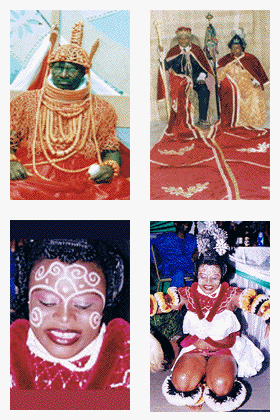 I
am Calabar, an historic seaport city and former
slave trading post, strategically located on the
Atlantic Coast near the Cameroon border. I am
capital of Nigeria's Cross River
State
and
considered the future superstar of West African
tourism. That bright, shiny future is just around
the corner according to the Governor's active
timetable. In
terms of economic potential, I am located near Port
Harcourt, heart of Nigeria's petroleum industry, a
magnet for business travelers from all corners of
the world.
I
am Calabar, an historic seaport city and former
slave trading post, strategically located on the
Atlantic Coast near the Cameroon border. I am
capital of Nigeria's Cross River
State
and
considered the future superstar of West African
tourism. That bright, shiny future is just around
the corner according to the Governor's active
timetable. In
terms of economic potential, I am located near Port
Harcourt, heart of Nigeria's petroleum industry, a
magnet for business travelers from all corners of
the world. 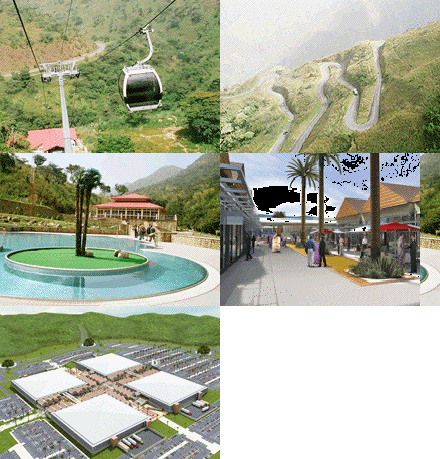 The
answer lies in the federal and state governments'
new focus on
The
answer lies in the federal and state governments'
new focus on 
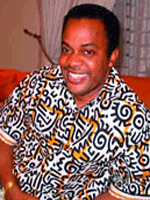 Nigeria,
Donald Duke Governor of Year...
Nigeria,
Donald Duke Governor of Year...