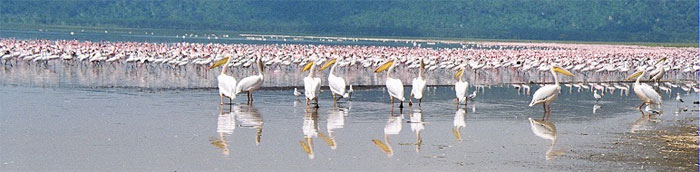
Photo
of waterfowl at Lake Nakuru by Muguette
Goufrani, Africa Travel
Magazine
NAIROBI, THE
ONLY CITY IN THE WORLD TO HAVE A WILDLIFE PARK
BY APOLINARI TAIRO, ETN
TANZANIA CORRESPONDENT | JUL 03, 2015
TANZANIA (eTN) - Selected to host the
40th Africa Travel Association (ATA)
World Congress November this year,
Nairobi, the Kenyan capital city, has
been rated the only city in the world
boasting of a wildlife park. Nairobi,
which is counted as the most beautiful
and a leading business metropolis in
East and Central Africa, is rated a
tourist-friendly city by its nightlife,
cool weather, accommodation services,
regional and global gatherings, as well
as a hub for regional tourism.
Nairobi prides itself on hosting the
regional headquarters of multinational
companies, and of being the powerhouse
driving the East Africa economy.
According to a Kenyan newspaper, the
Daily Nation, Nairobi has been counted
as the only city in the world that
boasts a game park. It quoted a
publication painting a rosy picture of
the city’s night life and mysteries,
which all in all, make it a
tourist-friendly metropolis and worth to
visit.
The publication mentioned the city to
have many more mysteries, but, most
attractive is the Nairobi National Park
which is located just a 10-minute drive
from the metropolis, and is home to a
variety of wild animals.
Nairobi National Park has raised wood
walkways that provide a panoramic view
of the park’s ecology. The visitor gets
a clear picture of what to look forward
to seeing. It was establlished by
British settlers in the 1940s, and
occupies some 117 square kilometers.
Home to more than 550 species of birds
and attracting some 150,000 visitors a
year, the park also acts as the lungs of
the city, bringing in fresh air to an
increasingly crowded capital.
The park is home to diverse wildlife,
from the African buffalo, impala,
waterbuck, Burchell’s zebra, hartebeest,
and ostrich to the nocturnal lion and
leopard.
Giraffes can also be seen loping about,
their elongated necks dwarfing the
acacia trees. For the bird watcher,
there are endless flocks to explore,
with an estimated over 500 permanent and
migratory species. The park is also one
of Kenya’s most successful rhino
sanctuaries. Both species of rhino,
white and black, can be found within the
park.
The southern boundary is formed by the
River Mbagathi and on hot, sunny days,
especially in August, herds of zebra,
wildebeest, and other ungulates flock to
quench their thirst. Beyond the river is
Maasai cattle country, which lies on the
migratory corridor through which the
animals access the Athi Kapiti plains
during the rainy season.
Another must-see place is the ivory
burning site monument, where then
President Moi burned 12 tons of ivory in
1989 as a gesture to persuade the world
to halt the trade.
Children on school trips flock to the
park by the hundreds to gape at this
magnificent urban jungle.
The Kenyan government has fostered a
tradition of hosting the ATA Congress
every ten years, said ATA Executive
Director Edward Bergman, adding, “On the
occasion of ATA’s 40th anniversary, we
are eager to return to Kenya for this
milestone in ATA’s history. We are
delighted to bring together the public
and private sectors, travel industry,
and media to participate in the
Congress.”
ATA Congress delegates include African
tourism ministers, tourist industry
professionals representing tourism
boards, destination representatives,
travel agents, tour operators, airlines,
hotels and accommodations, service
providers, and travel media.
Participants from the corporate,
nonprofit, and academic sectors are also
expected to attend along with travel and
hospitality students. Pre- and
post-Congress tours will also be
available to explore Magical Kenya
beyond the Congress.
By WorldtravelNews
Kenya: An
Exclusive Offer from Mara Toto Camp
Mara Toto Camp, Kenya, is everything
you would expect from a traditional
Masai Mara camp. Colonial in style (you
can’t miss the brass chandeliers), there
are five specially designed tents, which
not only draw on the highlights of the
camps stunning setting, but does so in
such a way you can completely relax.
When it comes to game viewing it’s the
prime leopard territory, along with the
annual wildebeest and zebra migration –
all which can be witnessed from your own
hammock.
Travelling as a large group or with
the whole family is becoming
increasingly popular, and we can offer a
six night stay with exclusive use of
Mara Toto Camp in the Masai Mara on a
full-board basis with local drinks, game
activity and laundry. This also includes
internal flights, road transfers and
international flights from London
Heathrow. Prices start from £3,500 per
person based on 10 people travelling.
To have exclusive use of this 10
person camp, means you only have to pay
for 6 out of the 10 people and then free
scheduled flights on top makes it in
excess of a huge 40% saving.
Valid for travel from now to 19
December 2015. ###
In the week that Lufthansa announce
new four and five-weekly flight service
to Nairobi, starting at 27 October, and
a week after Great Plains announces our
own fly free offers in Kenya and
Botswana, Great Plains Conservation have
come up with an additional offer that
will really fill those Airbus A340-300s
– certainly the front of the plane,
because now Kenya has become ever so
much affordable, and easy to get to,
travelers can have more money to travel
in extra comfort.
So for small groups heading for Mara
Toto Camp – Toto an endearing term for
child in Swahili – can now have
exclusivity of the camp and save up to
40% on the accommodation, plus much more
when you factor in the free flights to
and from the camp. The five tent camp,
sleeping 10, can be exclusively yours
for just 6 paying clients! If you have 8
guests in a group, you pay for 8 guests
and have the camp exclusively, saving
20%. If you have 10 guests, well you pay
for 10, but you still get free flights
(see box below for free flight details).
Valid now through to 19 December 2016.
Don’t forget to combine these new
Lufthansa services into Nairobi and out
from Johannesburg to take advantage of
the Great African Flying Adventure.
Great Plains Conservation,
www.greatplainsconservation.com
 The
East African Wild Life Society The
East African Wild Life Society
During
our editorial team's recent 40 day visit
to Kenya, we were fortunate to arrange a
meeting with the East African Wild Life
Society, one of the pillars of
conservation and ecotourism throughout a
vast and highly important sector of
Africa. We consider this one of the most
important interview sessions in our fact
finding mission. Here in brief capsule for
is a profile of this worthy organization,
which invites you to get involved.
The
East African Wild Life Society, EAWLS, was
formed in 1961. The Kenya and Tanzania
Wildlife Societies, both started in 1956,
joined together with wildlife enthusiasts
from Uganda, and thus EAWLS was born.
EAWLS was established as a membership
organization, as reflected in its
constitution, and is registered as a
Non-Governmental Organization, NGO, under
the NGO Act of 1990. For over forty years
now, EAWLS has been at the forefront of
efforts protecting endangered and
threatened species and habitats in East
Africa. E-mail: info@eawildlife.org
. Web ite:
www.eawildlife.org
 Kenya
Wildlife Service Kenya
Wildlife Service
www.kws.org
While in
Kenya on their second lengthy business
trip and tour in 12 months, our editors
visited the Kenya Wildlife Service
management at their attractive facilities
in Nairobi. As a result, we will be
featuring KWS prominently in coming
editions of Africa Travel Magazine and
this and other Worldscene web sites. For
the moment, we introduce our readers to
KWS with news releases and an excerpt from
the organization's excellent web
site:
"That
Kenya is a "land of contrasts" is not a
traveller's guide cliché. The
country straddles the equator, in the
South East is the Indian Ocean, and to the
west is lake Victoria - the second largest
fresh water lake in the world. The
vegetation varies from the dense tropical
forests, the mangrove forests along the
coast, to the shrubery of the arid desert
lands, to the thick mountainous forests
and alpine vegetation along the slopes of
the snowcapped Mount Kenya. Kenya's
landscape is most fascinating and diverse.
And it boasts some of the richest and
diverse variety of game in the Parks and
Reserves. Kenya Wildlife Service (KWS) is
charged with the protection and
conservation of the country's biodiversity
as presented by its fauna and flora. KWS's
role is as diverse as the country itself.
" Continued
RETURN OF THE
BONGO
Eighteen
African antelopes bred in North America
have arrived in Kenya in an effort to save
the species from extinction in its native
habitat, in the first ever 'repatriation'
of large zoo bred African
mammals.
The
shipment of the elegant mountain bongos
from a breeding program in U.S. and
Canadian zoos, are to be moved into a Game
ranch near Mt Kenya. A large antelope with
red fur interspersed with fine white
stripes, the mountain bongo- a native to
the Kenyan highlands, is considered a
prize specimen for zoos around the world.
The average male bongo weighs about 250 kg
(550 lbs) and its horns can grow to a
length of one meter (3 ft 3 in). There are
400 bongo living in American zoos, more
than four times the wild population, which
has been decimated by poaching and habitat
loss. The newly arrived 18 are the first
batch of 60 that will be taken to Kenya by
2006 in a project backed by the U.N.
Development Program and several
conservation organizations.
The
repatriated zoo antelopes will not be able
to survive in the wild, and will be kept
captive at the game ranch. It will be
their offspring that are eventually
released into the adjacent Mount Kenya
National Park in a few years, said Nancy
Chege, an environmentalist monitoring the
program.
This
program is great news for the diversity of
the Mt Kenya Forests, recently named a
World Heritage Site. The bongo has come to
symbolize this high and wild region, and
now visitors to the Mountain may once
again catch a glimpse of this rare and
elusive creature.
SNAKE
SAFARI
Kenya has
126 species of Snakes- yet most visitors
to the country leave without seeing one of
these shy and elusive reptiles. The
question is- What if you would actually
like to see one? An all new Specialized
Safari outfit is offering a Kenya Snakes
Safari- a genuine adventure that combines
wild walks, river rafting, visits to witch
doctors' caves and tracking down Kenya's
top 5 snake species.
The trip
is called the Big 5 Snake Safari in
reference to the popular term for the 5
most popular African Big Game species-
Lion, Leopard, Buffalo, Rhino and
Elephant.
In this
case- this Safari goes in search of the
most impressive species of African snake-
the Python, Boomslang, Puff Adder, Cobra
and the Mamba.
This trip
is run by some of Kenya's top reptile
experts and professional snake catchers.
The aim of the entire venture is to
promote education and awareness of snakes,
and to demonstrate through firsthand
experience that these creatures play an
important and fascinating role in African
ecosystems, and rarely live up to their
maligned and mythologized reputations as
aggressive killers.
Anyone
joining the safari will discover that
snakes are extremely shy of humans, and
will go to great lengths to avoid people.
This makes finding the 'Big 5î
species in a single safari a genuine
challenge.
In fact,
it's this challenge that makes this safari
what it is: an adventure- it involves a
lot of travel through a range of habitats
and landscapes, tracking down snakes
through forests, dry river beds, rocky
cliffs and mangroves. The safari takes in
plenty of other wildlife along the way as
well, as well as village visits, wild
camping, rafting and time off on one of
the world's best beaches.
If you
are looking for a wildlife safari that
doesn't involve taking photos from the
safety of a vehicle, and would like to get
out and explore and interact with wild
animals up close and personal, and have a
genuine adventure, then this is the trip
for you.
 KENYA
TOURIST BOARD rkwena@kenyatourism.org KENYA
TOURIST BOARD rkwena@kenyatourism.org
You can
see "Magical
Kenya" today
or tomorrow at your local theater, in the
exciting movie Tomb Raiders II. Then
you'll have some idea of why this country
has been captivating generations of North
American and world travelers. Africa
Travel Magazine is going on the road to
beat the drums for Kenya's 30th Jubilee
Congress in North America and beyond. For
the Africa Travel Association (ATA ), our
Kenya Story began at the birth of our
friendly, fully integrated, international,
nonprofit, nonpolitical, high-energy
travel association in 1975. Our launch
needed a focal point, a popular, well
known venue that would gain the spotlight
and attract North American travel agents.
Why did New York's Murray Vidockler and
his founding group select Nairobi, Kenya
out of 53 African capitals? The reasons
were plain to see and Kenya's major city
became the unanimous choice as venue for
ATA's first International Marketing
Congress. One of the first delegates to
sign was Elyse White, a New York City
travel agent. Elyse, who remains youthful
in her mid nineties, has enjoyed every ATA
congress ever since. When she writes me,
her e-mail nickname is "Mama
Safari.
Photos courtesy of
Kenya Tourism
|
 .
.




 We
have 1
We
have 1