|
Nov 14, 2015
1000 cruise tourists give major boost to
Kenya's tourism
MOMBASA,
Kenya - The tourism sector received a major
boost Thursday when a luxury cruise ship
docked at the port of Mombasa with more than
1,000 tourists and crew.
MS Nautica, which is operated by Oceania
Cruises, arrived in Mombasa for the second
time this year from Seychelles with 684
passengers and 386 crew members.
The ship's arrival pushed the number of
cruise tourists this year to more than 1,800
up from 900 in 2014.
The
majority of the holidaymakers were from the
US while others came from UK, France,
Germany, Belgium, Australia, Poland
Netherlands, Hong Kong and Thailand.
Others
were from South Africa, Portugal, Norway,
Canada, Brazil, Ireland, Sweden and
Switzerland.
Upon
arrival, some tourists flew over to the
world famous Maasai Mara reserve for game
drives while others travelled to Amboseli
and Tsavo East and West national parks.
Other
wildlife lovers went to Shimba Hills Game
Reserve and Mwalughanje Elephant Sanctuary
while some toured Mombasa town and Bombolulu
workshop cultural center.
A couple
from the US, Mary Williamson and her husband
George said they were excited to be in
Mombasa for a tour of the port city.
"We were
looking forward to visiting Mombasa so that
we could tour the town as well as visit the
cultural and historical sites," Mrs
Williamson said.
"We are
planning to come back for a long holiday so
that we can sample the tourist facilities
and relaxation on the alluring beaches," she
added.
DREAM COME TRUE
A German tourist Jan Haul from Hamburg said
he was delighted to be Mombasa for the first
time.
"April
next year, I will come with my nephew for a
one-week holiday specifically to celebrate
Easter here in Mombasa," Mr Haul said.
A couple
from California, Landa Parisi and Sami Salem
said their visit to Mombasa for the first
time was a dream come true as they had
longed to tour the coastal town.
On
Thursday, Kenya Tourism Board Managing
Director Muriithi Ndegwa said the arrival of
the cruise ship was a major boost to cruise
tourism in the country.
He noted
that the US and UK governments' lift of
travel advisories against Mombasa, Kwale and
Kilifi counties had lifted tourism in the
region.
The KTB
boss said cruise holidaymakers were of great
benefit to the sector since they go on
safari as well as visit historical, cultural
and handicraft community projects.
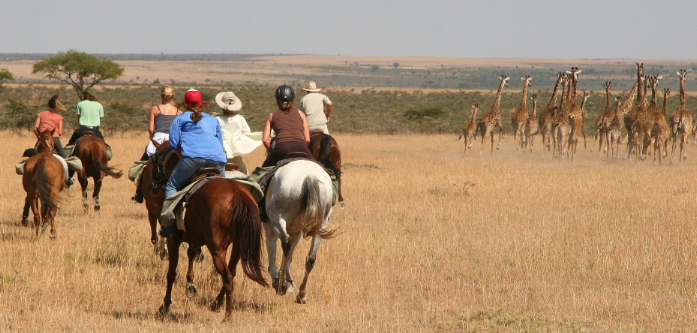
Horsing around the Masai Mara
Richard Powell joins a gonzo riding outfit to trek
across Kenya's epic game reserve, camping beneath
the stars and hanging onto his horses...
"It's like the Garden of Eden," our guide says,
"just beautiful..." and we draw up our reigns to
marvel in silent reverence at the vast landscape,
dotted with every wild animal we could have hoped to
see
Across this lush, buzzing vista, buffalo herd around
impala, eagles soar above wildebeest and elephants
charge fruit trees while lions wait patiently in the
tall savannah grass, deciding which to eat for
dinner.
Getting here is not easy... it takes days of hard
riding to earn a seat at this show.
Our journey begins in the capital, Nairobi, where we
transfer through gridlock traffic to a domestic
airport and board a 12-seat Cessna, heading
south-west over the Loita Plains, above the Kikuyu
Highlands and past the volcano-studded Great Rift
Valley.
An hour later we’re bumping down on a dirt-strip
that doubles as a gateway to the reserve and a
social hotspot for colourfully-dressed Masai
warriors. With no phone signal and no electricity
from here on in, it also represents the eye of a
needle through which few First-World foibles may
pass.
From here, a Land Rover bumps us along remote red
dirt roads to a campsite set in a grove of acacia
trees. This would be the first of three such sites,
and traversing between them for up to six hours a
day on horseback will require every inch of riding
skill we have.
There's barely time for a cold Kenyan Tusker beer
before we're heading out on our first ride when the
sun hangs low enough to bring the wildlife out to
feed. Here the guides quietly make their assessments
about your riding abilities and how closely they
need to stick to you, and whether you've been paired
with the right horse.
They’re an international bunch; a half-Argentinian,
half-Austrian lifer (he started working with Offbeat
at 18, and he's still there aged 33), an Australian
polo player from Dubai, a British safari guide from
Botswana, and a student volunteer and hunter from
England. The guests were from the UK, US, Germany,
Italy and Australia.
The horses were Abyssinian, thoroughbred and
cross-thoroughbreds, reared on the owner's farm, and
brought into the reserve via a seven-hour horsebox
slog. Mine was a pristinely-turned-out, polo-playing
gelding named Blondie, looking decidedly bling with
his dash of gold flecks and bright yellow mane.
After half an hour of sizing each other up at the
beginning, we knew we’d get on fine.
Being confident on your horse could be the most
important part of this adventure. Over the next
week, we would inch – day-by-day – ever closer to
prides of snarling lions, square up to scrappy
elephants and push back short-tempered bison... any
of which could outrun us, if they wanted to.
Being comfortable riding in English tack is
important too, as I noticed the countryside
Californians in our group had a hard time adjusting
to the bolt-upright British saddles which are at
odds with the Western-style 'armchairs' they use
back home.
The most accomplished riders tail the lead guide as
he opts to take the most daring routes, jumping over
felled trees left by head-charging pachyderm and
playing chicken with lions which may or may not have
eaten that day.
Every two to three days, camp packs up and shifts by
truck; with its canvas dining tent, shower, sleeping
and toilet tents resembling a well-appointed commune
when pitched at each of the three stunning oases.
On every ‘moving’ day, there is an epic ride to
reach the next site, which can be up to 50
kilometres away. That's a lot of riding - at high
altitude - across challenging terrain, galloping
across plains pockmarked with aardvark holes and
rocks, and cantering through stone-bed rivers with
vertigo-inducing banks...
Along the way, animal burrows are a constant hazard.
But if you're lucky enough for the person in front
of you to spot one through the dust clouds, avoid it
and shout "HOLE!" in time, you may not fall down it.
Organisers encourage guests to take out medical
insurance prior to arrival, but they also have their
own public liability insurance and membership to the
Flying Doctors organisation, in case of serious
injury requiring evacuation.
Nevertheless, there's a lot that can go wrong in the
middle of nowhere. The riding sections will
undoubtedly push you to your limits of
self-preservation, whether you opt to take the easy
option and stay back, or throw caution to the wind
and try to keep up with the lead guide.
Bullwhips protect guests from animal attacks, with
guides normally carrying little else. The Land Rover
variant of the trip, for non-riders, encourages
guests to get out and walk on the reserve, and here,
they are accompanied by a guard carrying a rifle.
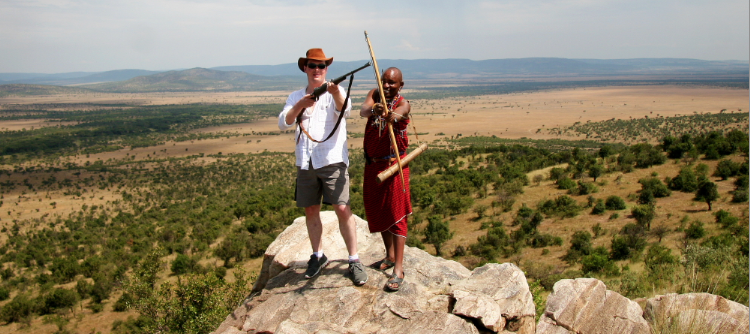
The one occasion we went out armed was to a mountain
we climbed first by car, then by foot to reach its
spectacular peak. Its nooks host several families of
cheetah and leopard, which we were warned to be on
our guard against, although we didn't see any as we
clambered about on its slopes.
We did not have to wait much longer before we did,
though...
On our first night at the third campsite, while
drinking beers around the fire on the banks of the
Mara River, our lead Masai guard, Nati, came over
saying he’d spotted a cheetah and asking if we
wanted to see it. Several seconds later we were
careering around the site in the Land Rover, shining
a spotlight until suddenly we caught a flash of
markings bolting into a bush.
Nati picked out an impala with the light, leading
the cheetah out into the open to its quarry. The
kill was artistic and eloquent in its execution and
despite the graphic scene; we drove over, clutching
our beers on the roof of the car, and sat transfixed
to watch it feed.
Other night-time highlights included Masai warriors
demonstrating their mating dance around the fire (a
hit with the ladies); driving out to party on the
plains after dark with James Brown booming from the
stereo, and running semi-clothed out of my tent at
4am as an elephant pushed down a nearby tree.
The camp’s 15-strong domestic staff of men from
various local tribes went above and beyond to give
the safari an extravagant feel...
Returning to my tent after dinner each evening, I
would without fail find my riding boots cleaned and
polished to perfection and my laundry scrubbed,
pressed and folded as if at a top-notch hotel.
The food and drink was impressive too, an array of
cuisine cooked up from fresh, imported and
locally-produced ingredients... ‘Would you like your
steak rare or well-done... with a nice Malbec or a
Bloody Mary?’ and ‘Breakfast eggs fried, scrambled
or poached?’
Riding for hours from the crack of dawn to emerge
over a hill and find the camp’s chef cooking
breakfast for you, and baking fresh bread – in the
middle of the plains – also ranks, for me, as a new
definition of decadence.
And our midday siestas in shady glades after picnic
lunches were something to savour too... like falling
asleep on the classroom rug after having your fill
of milk and biscuits at kindergarten.
At the end of the week, it was with some sadness
that I watched my fellow guests leave; while I moved
on to see the company's guest lodge, another hour’s
flight west.
The lodge at Sosian, the Samburu word for ‘Wild Date
Palm’, combines the tame with the wild. It's
certainly a stark contrast to Masai camping; with
its solid stone guest houses, swimming pool and main
house that harks back to colonial days with a
snooker table, grand piano and library.
Where the riding trip guests were in their 20s and
30s, at the game lodge the guests were mainly
parents in their 40s and 50s with young children.
I immediately missed the unashamedly gonzo set-up of
the anarchic riding outfit, with its unpredictable,
scruffy lead guide riding in flip-flops, nights
spent dancing around the camp fire and rock-hunting
by moonlight on the plains to shore up the Land
Rover's wheels after we’d hit a hole… (Cue the
Australian guide: “Let’s have a party, then fix the
car!”)
For many visitors, Sosian will perhaps be the
better-fitting choice; offering a quieter, safer and
more luxurious bush experience on its 24,000-acre
private working ranch, set on the Laikipia plateau.
It’s a beautiful area that offers more than 250
species of birdlife and an abundance of game species
with four of the big five species being found there,
plus other rarities such as wild dogs, Jackson’s
hartebeest and Grevy’s zebra.
Nonetheless, I’d be back on the mad travelling
horseback safari circus any day... at least for
another few years.
---
Cross the Masai Mara with Offbeat Safaris on
horseback over 7-nights from $5,550/£3,550/€4,400 or
10 nights from $7,700/£4,900/€6,075 per person
(Jan-Mar, Jun-Oct & Dec), excluding international
flights. Non-riders can take a Land Rover safari
from $6,500/£4,050/€5,020. Or stay at Sosian Lodge
from $4,500/£2,800/€3,470 per week, per person. (25%
discount for teenagers, 50% for children, per
person). Visit: http://www.offbeatsafaris.com
TRADE
AND TRAVEL DIRECTORY
Africa
Travel Magazine's Kenya Tourism Info
Center
Please
support these advertisers, who support
Africa on ATA's worldwide media
combination.
Kenya
Airways:
http://www.kenya-airways.com/feedback_form.html
http://www.kenya-airways.com/
Hat
Hotel and Adventure Tours
and Safaris, Nairobi.
Peter Muiruri aadvesafari@africaonline.co.ke
Aloha
Tours & Safaris
Kenya:
011-254-2-71-9330
USA 800-699-3191. Fax: 623-322-2755
E-mail: alohatres@aol.com, website:
www.aloha-safaris.com
Hotel Inter-Continental Nairobi
City Hall Way, PO Box 30353
Nairobi
Tel. 254 (2) 261 1000, Fax 254 (2) 210
675/214 617
Internet site:
http://www.interconti.com
e-mail: nairobi@interconti.com
DALLAGO
TOURS & SAFARIS
Martin Njagi, Loita House, Loita
Street
P.O. Box 66416, Nairobi, Tel: 254 2
331562 / 251992
Fax: 254 2 245174, Email:
martin@dallagotours.com
info@dallagotours.com
. Web: www.dallagotours.com
Lewa
Wildlife Conservancy
PO
Box 49918, Nairobi, Kenya,Tel +254
(164) 31405 Nairobi office +254 (2)
607893 fax 607197,
lewa@swiftkenya.com
Kenya
Association of Tour Operators
P.O. Box 48461, Nairobi, Kenya
Tel: +254 2 225570 Fax +254 2
218402
Email:
kato@africaonline.co.ke
Kenya
Tourism: http://www.kenyatourism.com/
Kenya Ecotourism:
http://www.eco-resorts.com/
Kenya
Wildlife Service: http://www.kenya-wildlife-service.org/
Wildlife Trust: http://www.sheldrickwildlifetrust.org/index.html
Promoting
Kenya in North
America
A
large Kenya delegation toured North
America in 2000, starting with a Kenya
Night event in Vancouver, BC, Canadam
followed by Seattle, Portland, San
Francisco and Los Angeles. The group
then proceeded to Las Vegas for ASTA's
World Travel Congress.
|
|

|
|
 .
. .
.



 We
have 1
We
have 1