|
||||||||||||||||||||
|
|
||||||||||||||||||||
|
World
Urban Forum Industry
Leaders Over
30 African Cities have hosted ATA events.
Each will star in our Great Cities sof
Africa magazine editions. Africans
in Canada Study
About
Vancouver: Visit our
North American
Website by Jerry W. Bird,
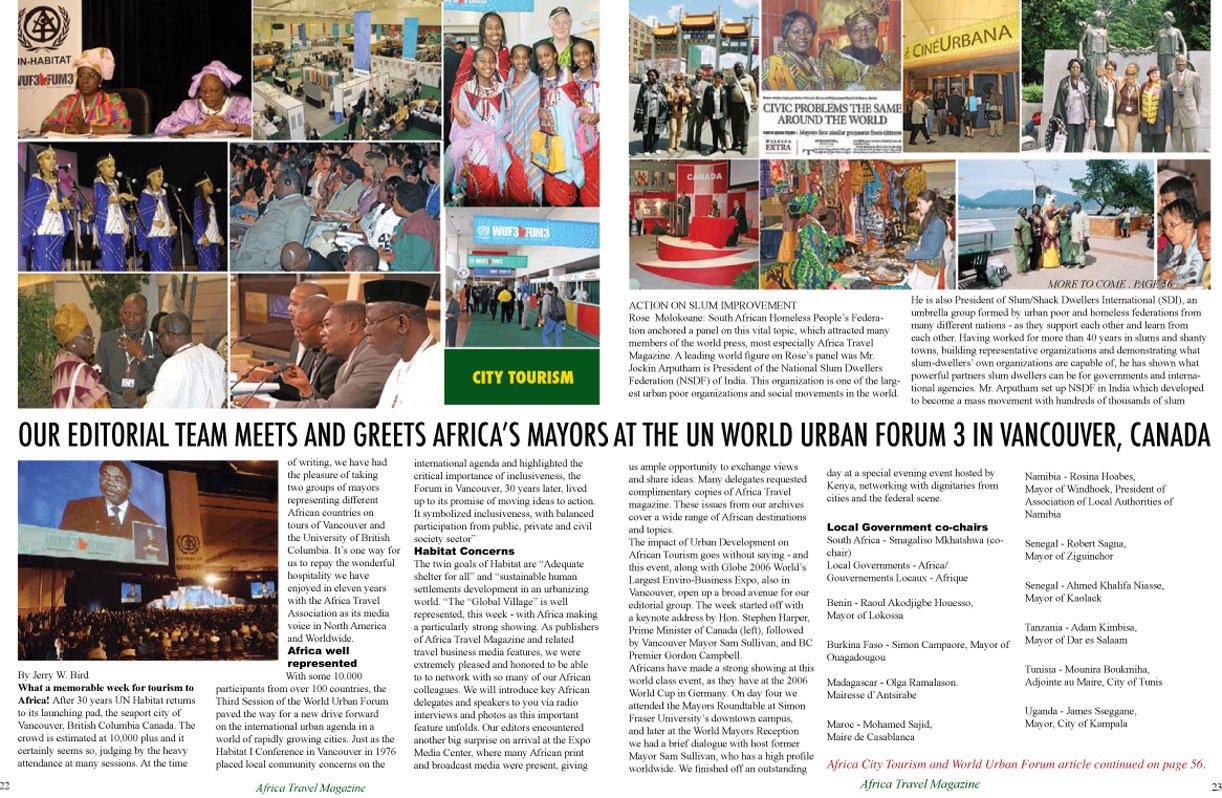
Editor . After 30 years
UN Habitat returns to its launching pad - the
seaport city of Vancouver,
British Columbia Canada. The crowd is estimated at
10,000 plus and it certainly seems so, judging by
the heavy attendance at many sessions. At the time
of writing, we have had the pleasure of taking two
groups of mayors representing different African
countries on tours of Vancouver and the University
of British Columbia. It's one way for us to repay
the wonderful hospitality we have enjoyed in eleven
years with the Africa Travel Association as its
media voice in North America and
Worldwide. With
some 10.000 participants from over 100 countries,
the Third Session of the World Urban Forum paved
the way for a new drive forward on the
international urban agenda in a world of rapidly
growing cities. Just as the Habitat I Conference in
Vancouver in 1976 placed local community concerns
on the international agenda and highlighted the
critical importance of inclusiveness, the Forum in
Vancouver, 30 years later, lived up to its promise
of moving ideas to action. It symbolized
inclusiveness, with balanced participation from
public, private and civil society sector"
The twin goals
of Habitat are "Adequate shelter for all" and
"sustainable human settlements development in an
urbanizing world. "The “Global Village”
is well represented, this week - with Africa making
a particularly strong showing. As publishers of
Africa Travel Magazine and related travel business
media features, we were extremely pleased and
honored to be able to to network with so many of
our African colleagues. We will introduce key
African delegates and speakers to you via radio
interviews and photos as this important feature
unfolds. Our editors encountered another big
surprise on arrival at the Expo Media Center, where
many African print and broadcast media were
present, giving us ample opportunity to exchange
views and share ideas. Many delegates requested
complimentary copies of Africa Travel magazine.
These issues from our archives cover a wide range
of African destinations and topics. The impact of
Urban Development on African Tourism goes without
saying - and this event, along with
Globe
2006 World's
Largest Enviro-Business Expo, also in Vancouver,
open up a broad avenue for our editorial group. The
week started off with a keynote address by Hon.
Stephen Harper, Prime Minister of Canada (left),
followed by Vancouver Mayor Sam Sullivan, and BC
Premier Gordon Campbell. Africans have
made a strong showing at this world class event, as
they have at the 2006 World Cup in Germany. On day
four we attended the Mayors Roundtable at Simon
Fraser University's downtown campus, and later at
the World Mayors Reception we had a brief dialogue
with host Mayor Sam Sullivan, who has a high
profile worldwide and will host the Winter Olympics
in 2010. We finished off an outstanding day at a
special evening event hosted by Kenya, networking
with dignitaries from cities and the federal
scene. AFRICANS ON
VIDEO: Comments from the African delegates are
available in Video Clips thanks to Sustainability
Corner, which operated from a broadcast stage at
the entrance to the Expo. Not only did our editor
get an opportunity to introduce Africa Travel
Magazine to the world, we were provided with
interviews from a wide cross section of Africans
from Cabinet Ministers to professionals of all
stripes. www.sustainabilitycorner.com
ACTION
ON SLUM
IMPROVEMENT AFRICA'S
MAYORS WERE FRONT AT CENTER AT WORLD URBAN
FORUM The Mayors'
Roundtable was co chaired by Smagaliso Mkhatshwa of
South Africa. Cities represented on the panel were
Kampala, Dar es Salaam, Casablanca, Tunis,
Windhoek, Ouagadougou and communities in Senegal,
Madagascar, Namibia, Burkina Faso and Benin, among
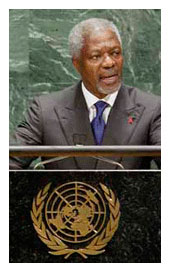
others. KOFI
ANNAN COMMENTS ON WUF3 Another
picture of cities, less visible from space but no
less real, is that of poverty and deprivation. More
than half the urban population of the developing
world lives in slums. with little or no access to
decent housing, clean water, basic sanitation,
regular jobs or steady income. The despair is such
that families are forced to choose between sending
their children to school or using them to fetch
water, and between feeding their children or saving
their meager funds to buy much-needed
medicines. In
our interdependent world, opportunity and
deprivation are inter linked. The consequences of
over-consumption and pollution, hunger and
deprivation, crime and insecurity know no borders.
If not handled well, they can generate intolerance,
migration, and even instability and extremism. On
the other hand, cities are also leading incubators
of knowledge, birthplaces of technological
innovation, and repositories of cultural riches.
Their density can make them efficient places for
living, consuming and producing. This
forum is well placed to address the challenges
facing cities and to advance the cause of
sustainable urban development. We have ideas and
best practices to guide us, including participatory
planning, "green" architecture, cooperative housing
finance and successful instances of inner city
revival. Together, we must scale up our efforts,
and make our urban planet more just, equitable and
sustainable for all its inhabitants. In that
hopeful spirit, please accept my best wishes for
the success of your important deliberations.
WHO TOOK
PART IN WUF3? FACES AND
VOICES OF AFRICA AT THIS EVENT SPEAKERS
FROM AFRICA Ali
Mohamed Shein: Vice President, Government of
Tanzania Harriette
Amissah Arthur, Director, KITE,
Ghana Mary
Balikungeri: Rwanda Women's Network,
Rwanda Tasneem
Essop: Minister of Environment, Planning and
Economic Development, Government of the Western
Cape, South Africa Eric
Falt: Director of the Division of Communications
& Public Information, United Nations
Environment Program (UNEP), Kenya Bhekokwakhe
Hamilton Cele: Transport Safety and Community
Liaison Officer, KwaZulu Natal, South
Africa Lamine
Mbassa: Director of Economic and Financial Affairs,
Communauté Urbaine de Douala (CUD),
Cameroon Jean-Pierre
Mbassi: Secretary General, United Cities &
Local Governments Africa Smangaliso
Mkhatshwa : Councillor of Tshwane, South
Africa Abbès
Mohsen: Mayor of Tunis, Tunisia; President
of the Féderation Nationale des Villes
Tunisiennes, Tunisia Rose
Molokoane: South African Homeless People's
Federation, South Africa Maria
Mutagamba: Minister of State for Urban Employment
& Poverty Alleviation, Government of Uganda,
Uganda John Pombe
Magufuli : Minister of Housing, Lands and Human
Settlements, Government of Tanzania, Co-Chair WUF
3 Lindiwe
Sisulu: Minister of Housing, Government of South
Africa Examples
of urban sustainability were just outside the doors
of WUF3. Delegates saw how a waste water treatment
plant works or cycle around the University of
British Columbia campus. Free guided tours took
them off the tourist track to see why Vancouver is
one of the most sustainable cities on the
planet. AFRICA
MUNICIPAL DEVELOPMENT
PARTNERSHIP |
||||||||||||||||||||






 ...
...
 Mayors,
such as
Mayors,
such as
 The
Holding of this Third Session of the World Urban
Forum in Vancouver has historic resonance for the
United Nations. It was in this great city that the
Agency we now know as UN-Habitat was born. It was
here, 30 years ago, that the idea of creating a
body to deal with where we live and how we live was
first brought into the international limelight.
Over the past three decades, our world has become
more urbanized, congested and polluted, and less
equitable. Satellite images reveal the huge and
growing "footprints" of cities: their sprawl into
plains, forest and wetlands; their fooling of
rivers, lakes and coastlines with waste; their
filling the air with smoke and smog. Cities which
are now home to half of humankind, are among the
greatest users of natural resources and major
emitters of greenhouse gases.
The
Holding of this Third Session of the World Urban
Forum in Vancouver has historic resonance for the
United Nations. It was in this great city that the
Agency we now know as UN-Habitat was born. It was
here, 30 years ago, that the idea of creating a
body to deal with where we live and how we live was
first brought into the international limelight.
Over the past three decades, our world has become
more urbanized, congested and polluted, and less
equitable. Satellite images reveal the huge and
growing "footprints" of cities: their sprawl into
plains, forest and wetlands; their fooling of
rivers, lakes and coastlines with waste; their
filling the air with smoke and smog. Cities which
are now home to half of humankind, are among the
greatest users of natural resources and major
emitters of greenhouse gases.